
Download Report

Thank you! Your submission has been received!
Oops! Something went wrong while submitting the form.

Read the Complete Report!

Thank you! Your submission has been received, Now you can view the complete report!
Oops! Something went wrong while submitting the form.

The Real Cost of Carrier Integrations

Cyrus-Karai
April 7, 2026
1 min read

How $500K Becomes $2M+ — And Why the Math Never Works Out

Competitors are quoting and binding faster, winning business that used to come easily. The problem is familiar: submission and quoting processes still run through email threads, spreadsheets, PDFs, and manual portal logins. The solution seems obvious — build an in-house API integration layer. Connect directly to your top carriers. Automate quote requests, bind confirmations, and policy issuance. Own the technology.

So you hire. Three engineers. Or maybe offshore, to stretch the budget further. Someone who’s worked at a carrier and understands their system structures. You set a budget of $500,000–$600,000 and a timeline of 12 months. The pitch is compelling: one-time investment, permanent competitive advantage.

Eighteen months later, you’ve spent over $1,000,000. The team needed more oversight than expected. Scoping gaps surfaced early, features like multi-location quoting weren’t in the original spec, because no one asked the right questions upfront. Two engineers moved on. You have three carrier connections in production for a single line of business, and one broke last month when they updated underwriting questions without notice.

Here’s the math that should have been on the whiteboard from day one: each carrier integration takes six to nine months and the maximum throughput is six integrations — for a single line of business. But wholesalers don’t operate in a single LOB. Clients want Workers’ Comp and BOP and General Liability. Each additional line multiplies the integration count. And none of this accounts for the hours consumed every month by maintenance on recently built connections.

Carrier integration is not a discrete build. It’s an ongoing operational capability, and the economics behave accordingly. This pattern repeats across the wholesale insurance industry with remarkable consistency. The details vary, but the arc is almost always the same.

It’s not a failure of execution. It’s a failure of scope. The project is never as contained as it looks on the whiteboard. Can you afford 18 months of building something that won’t differentiate — while your competitors are already out there selling?

Why Build In-House

Understanding why companies make this choice is important, because the reasoning is not irrational. The problems that drive the decision are real. The competitive pressure is real. The frustration with manual processes is real. What’s missing is an accurate picture of what the solution actually entails.

Trigger 1: Competitive Pressure Peaks

At some point, competitors start winning on speed. A quote-and-bind that took two days now takes them two hours. The intelligence from the field is consistent: companies that invested in digital connectivity are taking market share.

Sometimes the pressure arrives as a specific, painful failure closer to home — a quote lost in an email chain, a renewal that lapsed because a manual follow-up fell through the cracks, a client lost coverage during a gap that a digital workflow would have prevented.

The response: catch up. The fastest path seems to be building what competitors appear to have. What’s invisible from the outside, however, is how much those competitors actually spent — and continue to spend to maintain it — and how many now question whether in-house was the right call. Competitive urgency drives toward the fastest-seeming solution, not the most sustainable one.

The Big Mistake: Treating carrier API connectivity as a one-time project rather than an ongoing, resource-intensive operational capability. Connecting to a carrier API isn’t like installing software — it requires continuous maintenance as dozens of independent systems evolve on their own timelines.

Trigger 2: The Manual Process Breaking Point

The daily reality of quoting through manual workflows eventually becomes untenable. Your team is logging into 5, 8, 12 different carrier portals every day. Each has a different interface, its own login credentials, its own quirks. Submission data must be re-keyed from emails into spreadsheets, into portal forms — each handoff introducing error and eating time better spent on underwriting and client relationships.

The frustration compounds. A retail agent sends a submission. Your team enters it into one carrier portal, waits, enters it into another, waits again. Two days later, they assembled three quotes that took six hours of manual entry. The agent already placed the business elsewhere.

The build-it-yourself instinct makes sense: if we can automate these submissions using direct API connections, we eliminate the portal juggling, reduce errors, and get quotes back in minutes instead of days. The logic is sound. What’s underestimated is the engineering complexity required — and to keep it working once built.

Trigger 3: Control Over the Quoting Experience

In a desire to own the entire end-to-end quoting process, there’s often a strategic dimension to the build-out. Wholesalers want to control how quotes are presented to agents — their own UI, workflow logic, branding. The fear with a third-party platform is that the quoting experience becomes commoditized, and the wholesaler loses the ability to differentiate how they deliver quotes, not just that they deliver them.

This is a legitimate concern. But it introduces a critical confusion that trips up many organizations: the customer-facing experience and the backend connectivity layer are two fundamentally different engineering problems. You absolutely should own and customize your front-end — the interface retail agents interact with, the workflow logic that reflects underwriting appetite, the branding that reinforces market position.

What you don’t need to build is the plumbing underneath. The API connectivity, carrier data normalization, and ongoing maintenance of those connections are infrastructure problems, not differentiation problems. When companies confuse the two, they end up splitting their engineering resources between front-end experience work and back-end connectivity work — and both suffer. The team that should be building a best-in-class quoting interface is instead debugging carrier payload schemas.

How the Build Unravels

The first sign something’s off usually appears around month four or five. The initial estimate assumed a relatively clean integration process: a carrier provides documentation, the team builds to spec, the connection goes live. The reality is far messier.

Problem 1: Carrier APIs Are Moving Targets — And the UWQ Problem Is Massive

Carrier APIs do not arrive as finished products with stable specifications. They’re living systems, updated continuously in response to new product launches, regulatory changes, rating engine migrations, and internal platform upgrades. But the most persistent and painful changes aren’t the big, announced ones, rather they’re the constant shifts in underwriting questions and class codes.

Each carrier maintains over a thousand underwriting questions per line of business. These questions change regularly, and a carrier regularly updates their risk appetite, adds a new eligibility criterion, restructures their class code taxonomy, or modifies how they want location data submitted. These changes often arrive without advance notice. An integration that returned quotes yesterday now returns errors, and your team must spend days identifying which of the thousand-plus fields changed and how.

Now multiply this across carriers. Finding and maintaining common underwriting questions across ten carriers, each with their own terminology, their own question hierarchies, their own answer formats, is an enormous normalization challenge. It’s not just mapping; it’s ongoing reconciliation as each carrier independently evolves their question sets on their own timeline.

The math worsens fast. Each integration takes six to nine months to build properly. With three engineers working in parallel, maximum throughput is six integrations — and that covers a single line of business. When your clients need Workers’ Comp, BOP, and General Liability, the integration count doesn’t just add — it multiplies. A 10-carrier, 3-LOB strategy means 30 carrier-LOB integrations. Even with parallel development, you’re looking at years of build work before you’re fully connected.

And none of this includes the maintenance burden. With 10 carriers each making 3 to 5 significant changes per year, the team is managing 30+ change events annually — all before they’ve written a single line of new feature code.

Based on CoverForce’s integration experience across its carrier network: carriers make an average of 3–5 significant API changes per year. A 10-carrier integration portfolio generates 30+ change events annually that require immediate engineering response — and that’s before counting UWQ and class code updates, which happen far more frequently.

Problem 2: The Universal Data Model Problem

The single hardest technical challenge in carrier integration isn’t connecting to any one carrier’s API. It’s building a data model that works across all.

Each carrier structures data differently. One expects location data as a nested object with separate fields for each address component. Another wants a flat string. One carrier uses SIC codes for business classification; another uses NAICS; a third uses a proprietary class code system. Underwriting questions that seem equivalent, “Does the business have a swimming pool?” arrive in different formats, with different answer options, under different field names, in different positions within the payload.

The technology diversity compounds the problem. Carrier APIs span decades of technology evolution. Some carriers offer modern REST APIs with JSON payloads. Others still operate on SOAP services with XML schemas. A few require direct database connections or flat file exchanges. Building an integration layer that normalizes all of this — that presents a clean, consistent interface to your front-end, while translating to and from each carrier’s particular technology and data format behind the scenes — is an extraordinarily complex engineering challenge.

Most teams underestimate this by an order of magnitude. The initial plan assumes a shared data model with carrier-specific adapters. In practice, the adapters grow into complex subsystems of their own, each carrying carrier-specific business logic, exception handling, and transformation rules that resist standardization. The “universal” model becomes a patchwork of compromises that works adequately for three carriers and breaks when you add a fourth.

Problem 3: The Insurance + Engineering Knowledge Gap

Building a carrier integration layer requires a rare intersection of skills: deep insurance domain expertise and serious API systems engineering experience. This combination doesn’t really exist in the talent market.

Engineers who have built robust API platforms — who understand rate limiting, retry logic, webhook orchestration, data pipeline architecture, fault tolerance — typically come from fintech, e-commerce, or SaaS backgrounds. They’ve never navigated the specifics of insurance underwriting workflows, carrier submission requirements, or the nuances of how a BOP class code differs from a WC class code.

People who understand insurance — who can read a carrier’s underwriting guidelines and know what a submission needs to look like — typically haven’t built API abstraction layers. They know what the data should say, but not how to build the systems that move it reliably at scale.

Building a common abstraction layer requires a very specific engineering experience: not just API development, but the discipline of building middleware that brings together wildly diverse systems never designed to talk to each other. This is the core technical challenge: taking REST APIs, SOAP services, JSON payloads, XML schemas, and proprietary formats from dozens of carriers and unifying them behind a single, reliable interface. Great technology-building experience is as important as insurance domain knowledge, and finding both in the same team is exceptionally difficult.

This is why teams that look strong on paper still struggle. Three excellent engineers who have never built cross-system integration middleware and who are simultaneously learning insurance domain logic, will take twice as long and build something half as robust as a team that has done it many times before.

The True Cost — And Why the Budget Always Doubles

Every problem described above feeds the same outcome: the budget doubles, the timeline stretches, and the scope contracts. A 9-month project becomes 14 months. What was budgeted at $500,000 tracks toward $900,000 before the first carrier goes live.

The project doesn’t fail dramatically — it doesn’t get cancelled. It erodes. The ambitious 10-carrier plan becomes 5, then 4. Each review brings a revised timeline and a revised budget. Leadership remains committed because the sunk cost is real, and the original problem — the need for digital carrier connectivity — hasn’t gone away.

The project has consumed the engineering capacity that was supposed to be building the product features customers actually want and need. A year and a half of competitive product development has been traded for integration infrastructure that’s partially functional and fully expensive to maintain.

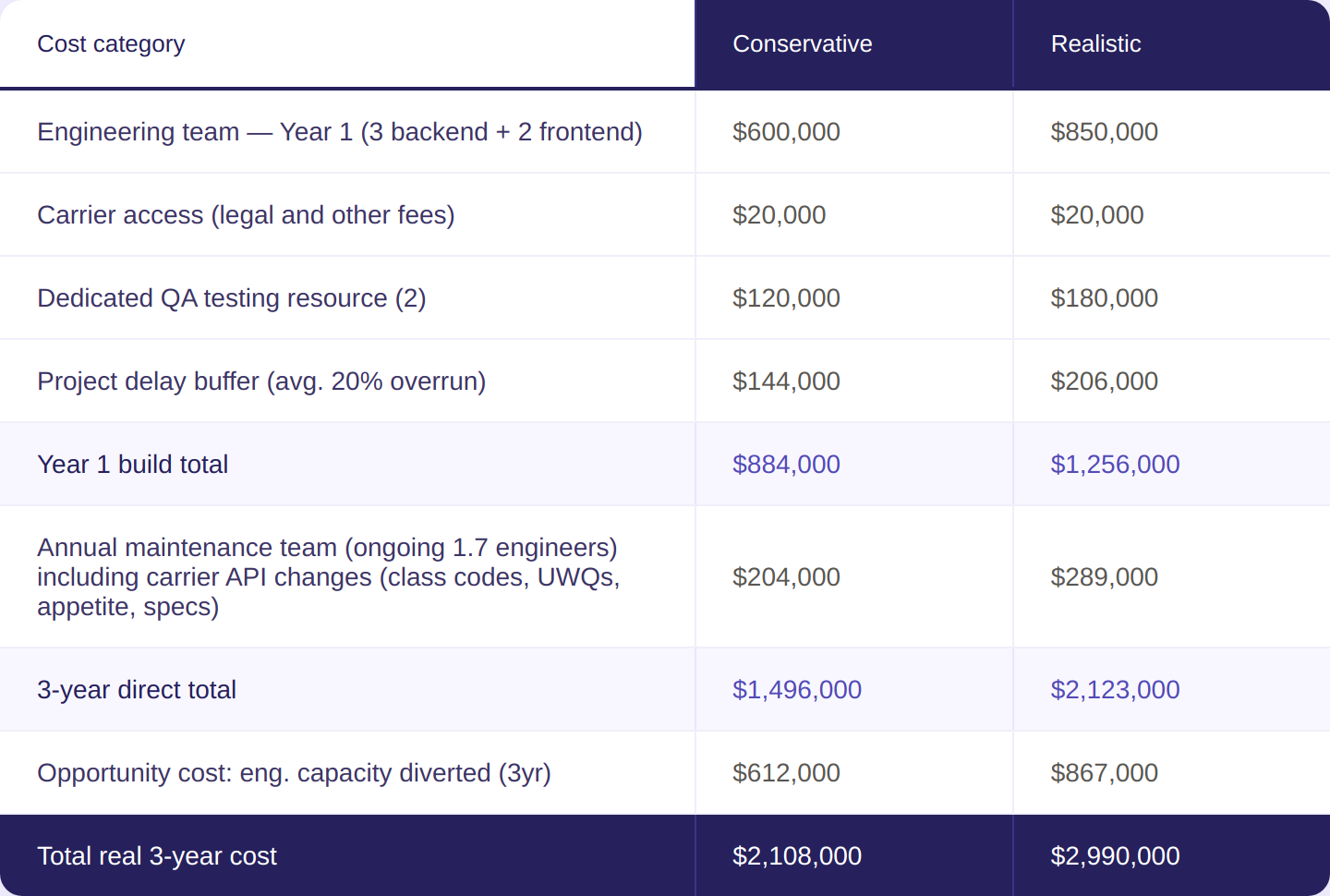
When organizations tally an in-house build, they typically only count direct engineering spend. What they undercount or miss entirely are the costs that make the actual number two to four times higher.

3-Year Total Cost of Ownership: In-House Carrier Integration Build
Article content

The opportunity cost line deserves particular attention, because it doesn’t appear in any budget. If your engineering team spends 40–45% of its capacity maintaining carrier integration infrastructure, and that team costs $1.2M annually, you’re paying $480,000–$540,000 per year in foregone product development — features not built, improvements not shipped, competitive ground not gained. Over three years, that number rivals the direct build cost itself.

A Different Way to Think About It

Think of carrier connectivity like a city’s water infrastructure. Every building needs clean water. But no one expects each building to dig a well, build its own treatment plant, and maintain its own pipe network from source to tap.

The city builds the water main, the shared infrastructure that serves everyone. Each building only needs to construct the last mile: the internal plumbing that delivers water exactly how they need it, to the specific fixtures and layouts that make their building unique.

Carrier integration works the same way. The connectivity layer — the API connections, the data normalization, the carrier relationship management, the ongoing maintenance — is the water main. It’s essential infrastructure that everyone in the wholesale insurance ecosystem needs. But it’s infrastructure that every participant shouldn’t have to build separately.

Your differentiation isn’t in the pipes. It’s in the last mile — the quoting experience, the underwriting logic, the client-facing workflows that make your operation distinct. That’s where your engineering investment should go.

How CoverForce Changes the Equation

CoverForce was built on this insight. By connecting once to CoverForce’s API platform, wholesalers and agents access a continuously updated, maintained, and growing network of carrier integrations — without inheriting build cost, maintenance burden, or the opportunity cost that comes with running that plumbing infrastructure themselves.

Today, CoverForce maintains live integrations with 25+ carriers across 6 lines of business — Workers’ Comp, BOP, CGL, Cyber, MPL, and Builders Risk — with 50+ unique carrier-LOB combinations in production. Carriers like CHUBB, GAIG, and Hiscox are connected across four lines of business each. The network continues to grow.

The costs that are fixed and unavoidable when building in-house — dedicated engineering capacity, carrier API monitoring, UWQ change management, relationship management — are amortized across CoverForce’s entire network of participants. Each organization pays a fraction of what they would bear alone, while benefiting from infrastructure maintained by a team whose sole focus is exactly this problem.

Engineering capacity returns to your core product. Carrier connections stay current without your team touching them. UWQ and class code changes are absorbed centrally. And the 12–18 months you would have spent building become months of competitive product development instead.

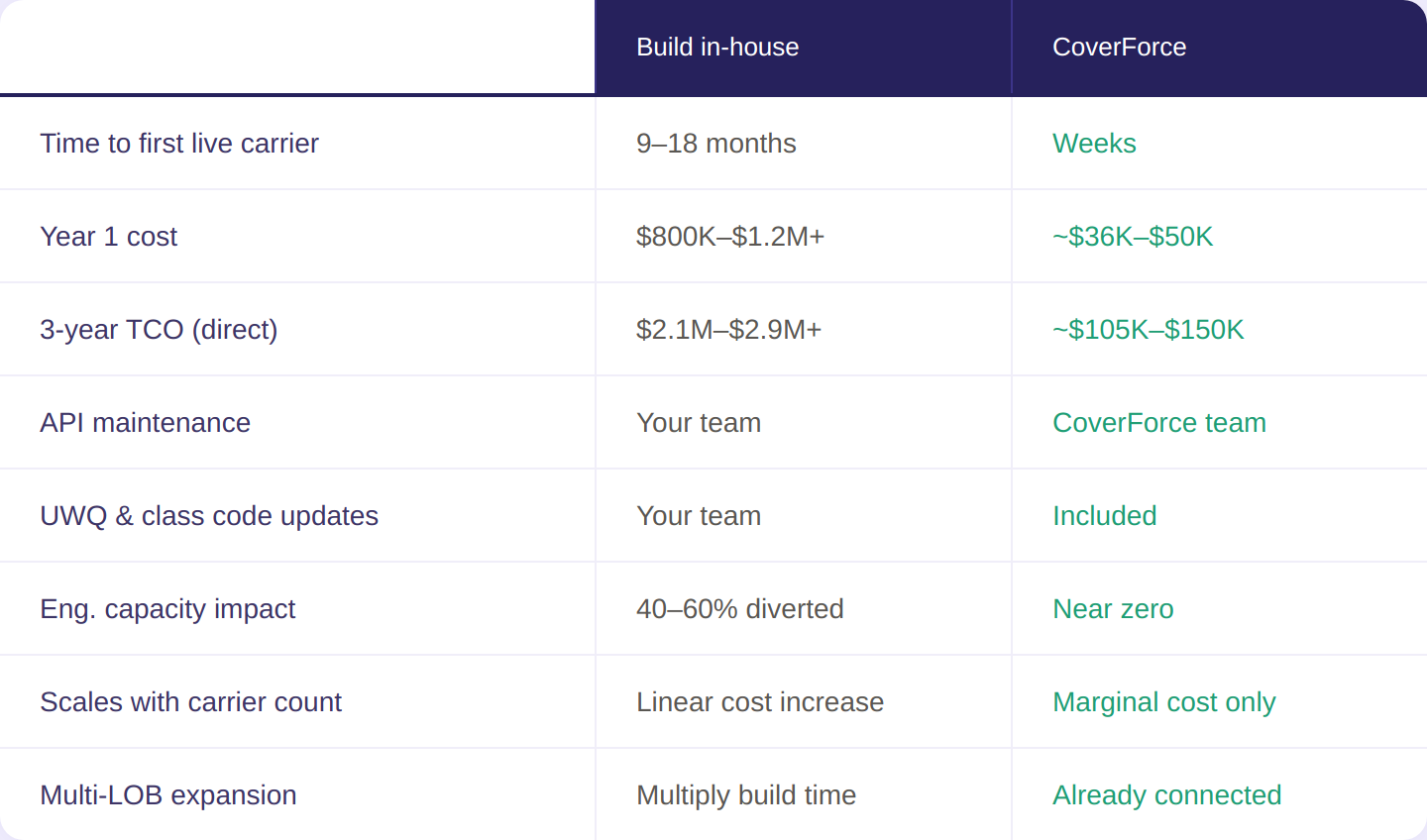
Internal Build vs. CoverForce Comparison
Article content

The Decision

Carrier connectivity will only expand in scope as insurers continue to modernize systems and regulatory expectations evolve. The capability will be mandatory.

The question isn’t whether your team can build carrier integrations. With enough time and money, they will eventually get there. The question is whether building and maintaining that infrastructure is the highest-value use of their time — and whether your organization should bear the full cost of a problem that every participant in the wholesale insurance ecosystem shares.

The wholesale market is consolidating around speed and access. The firms pulling ahead aren’t doing it by out-engineering their competitors on plumbing. They’re doing it by making smarter decisions about where engineering effort actually creates value.

Carrier integration is shared infrastructure. Building it independently multiplies cost without multiplying advantage. The firms that outperform will be those that directed engineering capital toward underwriting intelligence, analytics, and client experience — not those that spent it maintaining API connections.

How $500K Becomes $2M+ — And Why the Math Never Works Out

Competitors are quoting and binding faster, winning business that used to come easily. The problem is familiar: submission and quoting processes still run through email threads, spreadsheets, PDFs, and manual portal logins. The solution seems obvious — build an in-house API integration layer. Connect directly to your top carriers. Automate quote requests, bind confirmations, and policy issuance. Own the technology.

So you hire. Three engineers. Or maybe offshore, to stretch the budget further. Someone who’s worked at a carrier and understands their system structures. You set a budget of $500,000–$600,000 and a timeline of 12 months. The pitch is compelling: one-time investment, permanent competitive advantage.

Eighteen months later, you’ve spent over $1,000,000. The team needed more oversight than expected. Scoping gaps surfaced early, features like multi-location quoting weren’t in the original spec, because no one asked the right questions upfront. Two engineers moved on. You have three carrier connections in production for a single line of business, and one broke last month when they updated underwriting questions without notice.

Here’s the math that should have been on the whiteboard from day one: each carrier integration takes six to nine months and the maximum throughput is six integrations — for a single line of business. But wholesalers don’t operate in a single LOB. Clients want Workers’ Comp and BOP and General Liability. Each additional line multiplies the integration count. And none of this accounts for the hours consumed every month by maintenance on recently built connections.

Carrier integration is not a discrete build. It’s an ongoing operational capability, and the economics behave accordingly. This pattern repeats across the wholesale insurance industry with remarkable consistency. The details vary, but the arc is almost always the same.

It’s not a failure of execution. It’s a failure of scope. The project is never as contained as it looks on the whiteboard. Can you afford 18 months of building something that won’t differentiate — while your competitors are already out there selling?

Why Build In-House

Understanding why companies make this choice is important, because the reasoning is not irrational. The problems that drive the decision are real. The competitive pressure is real. The frustration with manual processes is real. What’s missing is an accurate picture of what the solution actually entails.

Trigger 1: Competitive Pressure Peaks

At some point, competitors start winning on speed. A quote-and-bind that took two days now takes them two hours. The intelligence from the field is consistent: companies that invested in digital connectivity are taking market share.

Sometimes the pressure arrives as a specific, painful failure closer to home — a quote lost in an email chain, a renewal that lapsed because a manual follow-up fell through the cracks, a client lost coverage during a gap that a digital workflow would have prevented.

The response: catch up. The fastest path seems to be building what competitors appear to have. What’s invisible from the outside, however, is how much those competitors actually spent — and continue to spend to maintain it — and how many now question whether in-house was the right call. Competitive urgency drives toward the fastest-seeming solution, not the most sustainable one.

The Big Mistake: Treating carrier API connectivity as a one-time project rather than an ongoing, resource-intensive operational capability. Connecting to a carrier API isn’t like installing software — it requires continuous maintenance as dozens of independent systems evolve on their own timelines.

Trigger 2: The Manual Process Breaking Point

The daily reality of quoting through manual workflows eventually becomes untenable. Your team is logging into 5, 8, 12 different carrier portals every day. Each has a different interface, its own login credentials, its own quirks. Submission data must be re-keyed from emails into spreadsheets, into portal forms — each handoff introducing error and eating time better spent on underwriting and client relationships.

The frustration compounds. A retail agent sends a submission. Your team enters it into one carrier portal, waits, enters it into another, waits again. Two days later, they assembled three quotes that took six hours of manual entry. The agent already placed the business elsewhere.

The build-it-yourself instinct makes sense: if we can automate these submissions using direct API connections, we eliminate the portal juggling, reduce errors, and get quotes back in minutes instead of days. The logic is sound. What’s underestimated is the engineering complexity required — and to keep it working once built.

Trigger 3: Control Over the Quoting Experience

In a desire to own the entire end-to-end quoting process, there’s often a strategic dimension to the build-out. Wholesalers want to control how quotes are presented to agents — their own UI, workflow logic, branding. The fear with a third-party platform is that the quoting experience becomes commoditized, and the wholesaler loses the ability to differentiate how they deliver quotes, not just that they deliver them.

This is a legitimate concern. But it introduces a critical confusion that trips up many organizations: the customer-facing experience and the backend connectivity layer are two fundamentally different engineering problems. You absolutely should own and customize your front-end — the interface retail agents interact with, the workflow logic that reflects underwriting appetite, the branding that reinforces market position.

What you don’t need to build is the plumbing underneath. The API connectivity, carrier data normalization, and ongoing maintenance of those connections are infrastructure problems, not differentiation problems. When companies confuse the two, they end up splitting their engineering resources between front-end experience work and back-end connectivity work — and both suffer. The team that should be building a best-in-class quoting interface is instead debugging carrier payload schemas.

How the Build Unravels

The first sign something’s off usually appears around month four or five. The initial estimate assumed a relatively clean integration process: a carrier provides documentation, the team builds to spec, the connection goes live. The reality is far messier.

Problem 1: Carrier APIs Are Moving Targets — And the UWQ Problem Is Massive

Carrier APIs do not arrive as finished products with stable specifications. They’re living systems, updated continuously in response to new product launches, regulatory changes, rating engine migrations, and internal platform upgrades. But the most persistent and painful changes aren’t the big, announced ones, rather they’re the constant shifts in underwriting questions and class codes.

Each carrier maintains over a thousand underwriting questions per line of business. These questions change regularly, and a carrier regularly updates their risk appetite, adds a new eligibility criterion, restructures their class code taxonomy, or modifies how they want location data submitted. These changes often arrive without advance notice. An integration that returned quotes yesterday now returns errors, and your team must spend days identifying which of the thousand-plus fields changed and how.

Now multiply this across carriers. Finding and maintaining common underwriting questions across ten carriers, each with their own terminology, their own question hierarchies, their own answer formats, is an enormous normalization challenge. It’s not just mapping; it’s ongoing reconciliation as each carrier independently evolves their question sets on their own timeline.

The math worsens fast. Each integration takes six to nine months to build properly. With three engineers working in parallel, maximum throughput is six integrations — and that covers a single line of business. When your clients need Workers’ Comp, BOP, and General Liability, the integration count doesn’t just add — it multiplies. A 10-carrier, 3-LOB strategy means 30 carrier-LOB integrations. Even with parallel development, you’re looking at years of build work before you’re fully connected.

And none of this includes the maintenance burden. With 10 carriers each making 3 to 5 significant changes per year, the team is managing 30+ change events annually — all before they’ve written a single line of new feature code.

Based on CoverForce’s integration experience across its carrier network: carriers make an average of 3–5 significant API changes per year. A 10-carrier integration portfolio generates 30+ change events annually that require immediate engineering response — and that’s before counting UWQ and class code updates, which happen far more frequently.

Problem 2: The Universal Data Model Problem

The single hardest technical challenge in carrier integration isn’t connecting to any one carrier’s API. It’s building a data model that works across all.

Each carrier structures data differently. One expects location data as a nested object with separate fields for each address component. Another wants a flat string. One carrier uses SIC codes for business classification; another uses NAICS; a third uses a proprietary class code system. Underwriting questions that seem equivalent, “Does the business have a swimming pool?” arrive in different formats, with different answer options, under different field names, in different positions within the payload.

The technology diversity compounds the problem. Carrier APIs span decades of technology evolution. Some carriers offer modern REST APIs with JSON payloads. Others still operate on SOAP services with XML schemas. A few require direct database connections or flat file exchanges. Building an integration layer that normalizes all of this — that presents a clean, consistent interface to your front-end, while translating to and from each carrier’s particular technology and data format behind the scenes — is an extraordinarily complex engineering challenge.

Most teams underestimate this by an order of magnitude. The initial plan assumes a shared data model with carrier-specific adapters. In practice, the adapters grow into complex subsystems of their own, each carrying carrier-specific business logic, exception handling, and transformation rules that resist standardization. The “universal” model becomes a patchwork of compromises that works adequately for three carriers and breaks when you add a fourth.

Problem 3: The Insurance + Engineering Knowledge Gap

Building a carrier integration layer requires a rare intersection of skills: deep insurance domain expertise and serious API systems engineering experience. This combination doesn’t really exist in the talent market.

Engineers who have built robust API platforms — who understand rate limiting, retry logic, webhook orchestration, data pipeline architecture, fault tolerance — typically come from fintech, e-commerce, or SaaS backgrounds. They’ve never navigated the specifics of insurance underwriting workflows, carrier submission requirements, or the nuances of how a BOP class code differs from a WC class code.

People who understand insurance — who can read a carrier’s underwriting guidelines and know what a submission needs to look like — typically haven’t built API abstraction layers. They know what the data should say, but not how to build the systems that move it reliably at scale.

Building a common abstraction layer requires a very specific engineering experience: not just API development, but the discipline of building middleware that brings together wildly diverse systems never designed to talk to each other. This is the core technical challenge: taking REST APIs, SOAP services, JSON payloads, XML schemas, and proprietary formats from dozens of carriers and unifying them behind a single, reliable interface. Great technology-building experience is as important as insurance domain knowledge, and finding both in the same team is exceptionally difficult.

This is why teams that look strong on paper still struggle. Three excellent engineers who have never built cross-system integration middleware and who are simultaneously learning insurance domain logic, will take twice as long and build something half as robust as a team that has done it many times before.

The True Cost — And Why the Budget Always Doubles

Every problem described above feeds the same outcome: the budget doubles, the timeline stretches, and the scope contracts. A 9-month project becomes 14 months. What was budgeted at $500,000 tracks toward $900,000 before the first carrier goes live.

The project doesn’t fail dramatically — it doesn’t get cancelled. It erodes. The ambitious 10-carrier plan becomes 5, then 4. Each review brings a revised timeline and a revised budget. Leadership remains committed because the sunk cost is real, and the original problem — the need for digital carrier connectivity — hasn’t gone away.

The project has consumed the engineering capacity that was supposed to be building the product features customers actually want and need. A year and a half of competitive product development has been traded for integration infrastructure that’s partially functional and fully expensive to maintain.

When organizations tally an in-house build, they typically only count direct engineering spend. What they undercount or miss entirely are the costs that make the actual number two to four times higher.

3-Year Total Cost of Ownership: In-House Carrier Integration Build

Article content

The opportunity cost line deserves particular attention, because it doesn’t appear in any budget. If your engineering team spends 40–45% of its capacity maintaining carrier integration infrastructure, and that team costs $1.2M annually, you’re paying $480,000–$540,000 per year in foregone product development — features not built, improvements not shipped, competitive ground not gained. Over three years, that number rivals the direct build cost itself.

A Different Way to Think About It

Think of carrier connectivity like a city’s water infrastructure. Every building needs clean water. But no one expects each building to dig a well, build its own treatment plant, and maintain its own pipe network from source to tap.

The city builds the water main, the shared infrastructure that serves everyone. Each building only needs to construct the last mile: the internal plumbing that delivers water exactly how they need it, to the specific fixtures and layouts that make their building unique.

Carrier integration works the same way. The connectivity layer — the API connections, the data normalization, the carrier relationship management, the ongoing maintenance — is the water main. It’s essential infrastructure that everyone in the wholesale insurance ecosystem needs. But it’s infrastructure that every participant shouldn’t have to build separately.

Your differentiation isn’t in the pipes. It’s in the last mile — the quoting experience, the underwriting logic, the client-facing workflows that make your operation distinct. That’s where your engineering investment should go.

How CoverForce Changes the Equation

CoverForce was built on this insight. By connecting once to CoverForce’s API platform, wholesalers and agents access a continuously updated, maintained, and growing network of carrier integrations — without inheriting build cost, maintenance burden, or the opportunity cost that comes with running that plumbing infrastructure themselves.

Today, CoverForce maintains live integrations with 25+ carriers across 6 lines of business — Workers’ Comp, BOP, CGL, Cyber, MPL, and Builders Risk — with 50+ unique carrier-LOB combinations in production. Carriers like CHUBB, GAIG, and Hiscox are connected across four lines of business each. The network continues to grow.

The costs that are fixed and unavoidable when building in-house — dedicated engineering capacity, carrier API monitoring, UWQ change management, relationship management — are amortized across CoverForce’s entire network of participants. Each organization pays a fraction of what they would bear alone, while benefiting from infrastructure maintained by a team whose sole focus is exactly this problem.

Engineering capacity returns to your core product. Carrier connections stay current without your team touching them. UWQ and class code changes are absorbed centrally. And the 12–18 months you would have spent building become months of competitive product development instead.

Internal Build vs. CoverForce Comparison

Article content

The Decision

Carrier connectivity will only expand in scope as insurers continue to modernize systems and regulatory expectations evolve. The capability will be mandatory.

The question isn’t whether your team can build carrier integrations. With enough time and money, they will eventually get there. The question is whether building and maintaining that infrastructure is the highest-value use of their time — and whether your organization should bear the full cost of a problem that every participant in the wholesale insurance ecosystem shares.

The wholesale market is consolidating around speed and access. The firms pulling ahead aren’t doing it by out-engineering their competitors on plumbing. They’re doing it by making smarter decisions about where engineering effort actually creates value.

Carrier integration is shared infrastructure. Building it independently multiplies cost without multiplying advantage. The firms that outperform will be those that directed engineering capital toward underwriting intelligence, analytics, and client experience — not those that spent it maintaining API connections.

Related Articles

Cyrus-Karai
April 7, 2026
1 min read

How $500K Becomes $2M+ — And Why the Math Never Works Out

Competitors are quoting and binding faster, winning business that used to come easily. The problem is familiar: submission and quoting processes still run through email threads, spreadsheets, PDFs, and manual portal logins. The solution seems obvious — build an in-house API integration layer. Connect directly to your top carriers. Automate quote requests, bind confirmations, and policy issuance. Own the technology.

So you hire. Three engineers. Or maybe offshore, to stretch the budget further. Someone who’s worked at a carrier and understands their system structures. You set a budget of $500,000–$600,000 and a timeline of 12 months. The pitch is compelling: one-time investment, permanent competitive advantage.

Eighteen months later, you’ve spent over $1,000,000. The team needed more oversight than expected. Scoping gaps surfaced early, features like multi-location quoting weren’t in the original spec, because no one asked the right questions upfront. Two engineers moved on. You have three carrier connections in production for a single line of business, and one broke last month when they updated underwriting questions without notice.

Here’s the math that should have been on the whiteboard from day one: each carrier integration takes six to nine months and the maximum throughput is six integrations — for a single line of business. But wholesalers don’t operate in a single LOB. Clients want Workers’ Comp and BOP and General Liability. Each additional line multiplies the integration count. And none of this accounts for the hours consumed every month by maintenance on recently built connections.

Carrier integration is not a discrete build. It’s an ongoing operational capability, and the economics behave accordingly. This pattern repeats across the wholesale insurance industry with remarkable consistency. The details vary, but the arc is almost always the same.

It’s not a failure of execution. It’s a failure of scope. The project is never as contained as it looks on the whiteboard. Can you afford 18 months of building something that won’t differentiate — while your competitors are already out there selling?

Why Build In-House

Understanding why companies make this choice is important, because the reasoning is not irrational. The problems that drive the decision are real. The competitive pressure is real. The frustration with manual processes is real. What’s missing is an accurate picture of what the solution actually entails.

Trigger 1: Competitive Pressure Peaks

At some point, competitors start winning on speed. A quote-and-bind that took two days now takes them two hours. The intelligence from the field is consistent: companies that invested in digital connectivity are taking market share.

Sometimes the pressure arrives as a specific, painful failure closer to home — a quote lost in an email chain, a renewal that lapsed because a manual follow-up fell through the cracks, a client lost coverage during a gap that a digital workflow would have prevented.

The response: catch up. The fastest path seems to be building what competitors appear to have. What’s invisible from the outside, however, is how much those competitors actually spent — and continue to spend to maintain it — and how many now question whether in-house was the right call. Competitive urgency drives toward the fastest-seeming solution, not the most sustainable one.

The Big Mistake: Treating carrier API connectivity as a one-time project rather than an ongoing, resource-intensive operational capability. Connecting to a carrier API isn’t like installing software — it requires continuous maintenance as dozens of independent systems evolve on their own timelines.

Trigger 2: The Manual Process Breaking Point

The daily reality of quoting through manual workflows eventually becomes untenable. Your team is logging into 5, 8, 12 different carrier portals every day. Each has a different interface, its own login credentials, its own quirks. Submission data must be re-keyed from emails into spreadsheets, into portal forms — each handoff introducing error and eating time better spent on underwriting and client relationships.

The frustration compounds. A retail agent sends a submission. Your team enters it into one carrier portal, waits, enters it into another, waits again. Two days later, they assembled three quotes that took six hours of manual entry. The agent already placed the business elsewhere.

The build-it-yourself instinct makes sense: if we can automate these submissions using direct API connections, we eliminate the portal juggling, reduce errors, and get quotes back in minutes instead of days. The logic is sound. What’s underestimated is the engineering complexity required — and to keep it working once built.

Trigger 3: Control Over the Quoting Experience

In a desire to own the entire end-to-end quoting process, there’s often a strategic dimension to the build-out. Wholesalers want to control how quotes are presented to agents — their own UI, workflow logic, branding. The fear with a third-party platform is that the quoting experience becomes commoditized, and the wholesaler loses the ability to differentiate how they deliver quotes, not just that they deliver them.

This is a legitimate concern. But it introduces a critical confusion that trips up many organizations: the customer-facing experience and the backend connectivity layer are two fundamentally different engineering problems. You absolutely should own and customize your front-end — the interface retail agents interact with, the workflow logic that reflects underwriting appetite, the branding that reinforces market position.

What you don’t need to build is the plumbing underneath. The API connectivity, carrier data normalization, and ongoing maintenance of those connections are infrastructure problems, not differentiation problems. When companies confuse the two, they end up splitting their engineering resources between front-end experience work and back-end connectivity work — and both suffer. The team that should be building a best-in-class quoting interface is instead debugging carrier payload schemas.

How the Build Unravels

The first sign something’s off usually appears around month four or five. The initial estimate assumed a relatively clean integration process: a carrier provides documentation, the team builds to spec, the connection goes live. The reality is far messier.

Problem 1: Carrier APIs Are Moving Targets — And the UWQ Problem Is Massive

Carrier APIs do not arrive as finished products with stable specifications. They’re living systems, updated continuously in response to new product launches, regulatory changes, rating engine migrations, and internal platform upgrades. But the most persistent and painful changes aren’t the big, announced ones, rather they’re the constant shifts in underwriting questions and class codes.

Each carrier maintains over a thousand underwriting questions per line of business. These questions change regularly, and a carrier regularly updates their risk appetite, adds a new eligibility criterion, restructures their class code taxonomy, or modifies how they want location data submitted. These changes often arrive without advance notice. An integration that returned quotes yesterday now returns errors, and your team must spend days identifying which of the thousand-plus fields changed and how.

Now multiply this across carriers. Finding and maintaining common underwriting questions across ten carriers, each with their own terminology, their own question hierarchies, their own answer formats, is an enormous normalization challenge. It’s not just mapping; it’s ongoing reconciliation as each carrier independently evolves their question sets on their own timeline.

The math worsens fast. Each integration takes six to nine months to build properly. With three engineers working in parallel, maximum throughput is six integrations — and that covers a single line of business. When your clients need Workers’ Comp, BOP, and General Liability, the integration count doesn’t just add — it multiplies. A 10-carrier, 3-LOB strategy means 30 carrier-LOB integrations. Even with parallel development, you’re looking at years of build work before you’re fully connected.

And none of this includes the maintenance burden. With 10 carriers each making 3 to 5 significant changes per year, the team is managing 30+ change events annually — all before they’ve written a single line of new feature code.

Based on CoverForce’s integration experience across its carrier network: carriers make an average of 3–5 significant API changes per year. A 10-carrier integration portfolio generates 30+ change events annually that require immediate engineering response — and that’s before counting UWQ and class code updates, which happen far more frequently.

Problem 2: The Universal Data Model Problem

The single hardest technical challenge in carrier integration isn’t connecting to any one carrier’s API. It’s building a data model that works across all.

Each carrier structures data differently. One expects location data as a nested object with separate fields for each address component. Another wants a flat string. One carrier uses SIC codes for business classification; another uses NAICS; a third uses a proprietary class code system. Underwriting questions that seem equivalent, “Does the business have a swimming pool?” arrive in different formats, with different answer options, under different field names, in different positions within the payload.

The technology diversity compounds the problem. Carrier APIs span decades of technology evolution. Some carriers offer modern REST APIs with JSON payloads. Others still operate on SOAP services with XML schemas. A few require direct database connections or flat file exchanges. Building an integration layer that normalizes all of this — that presents a clean, consistent interface to your front-end, while translating to and from each carrier’s particular technology and data format behind the scenes — is an extraordinarily complex engineering challenge.

Most teams underestimate this by an order of magnitude. The initial plan assumes a shared data model with carrier-specific adapters. In practice, the adapters grow into complex subsystems of their own, each carrying carrier-specific business logic, exception handling, and transformation rules that resist standardization. The “universal” model becomes a patchwork of compromises that works adequately for three carriers and breaks when you add a fourth.

Problem 3: The Insurance + Engineering Knowledge Gap

Building a carrier integration layer requires a rare intersection of skills: deep insurance domain expertise and serious API systems engineering experience. This combination doesn’t really exist in the talent market.

Engineers who have built robust API platforms — who understand rate limiting, retry logic, webhook orchestration, data pipeline architecture, fault tolerance — typically come from fintech, e-commerce, or SaaS backgrounds. They’ve never navigated the specifics of insurance underwriting workflows, carrier submission requirements, or the nuances of how a BOP class code differs from a WC class code.

People who understand insurance — who can read a carrier’s underwriting guidelines and know what a submission needs to look like — typically haven’t built API abstraction layers. They know what the data should say, but not how to build the systems that move it reliably at scale.

Building a common abstraction layer requires a very specific engineering experience: not just API development, but the discipline of building middleware that brings together wildly diverse systems never designed to talk to each other. This is the core technical challenge: taking REST APIs, SOAP services, JSON payloads, XML schemas, and proprietary formats from dozens of carriers and unifying them behind a single, reliable interface. Great technology-building experience is as important as insurance domain knowledge, and finding both in the same team is exceptionally difficult.

This is why teams that look strong on paper still struggle. Three excellent engineers who have never built cross-system integration middleware and who are simultaneously learning insurance domain logic, will take twice as long and build something half as robust as a team that has done it many times before.

The True Cost — And Why the Budget Always Doubles

Every problem described above feeds the same outcome: the budget doubles, the timeline stretches, and the scope contracts. A 9-month project becomes 14 months. What was budgeted at $500,000 tracks toward $900,000 before the first carrier goes live.

The project doesn’t fail dramatically — it doesn’t get cancelled. It erodes. The ambitious 10-carrier plan becomes 5, then 4. Each review brings a revised timeline and a revised budget. Leadership remains committed because the sunk cost is real, and the original problem — the need for digital carrier connectivity — hasn’t gone away.

The project has consumed the engineering capacity that was supposed to be building the product features customers actually want and need. A year and a half of competitive product development has been traded for integration infrastructure that’s partially functional and fully expensive to maintain.

When organizations tally an in-house build, they typically only count direct engineering spend. What they undercount or miss entirely are the costs that make the actual number two to four times higher.

3-Year Total Cost of Ownership: In-House Carrier Integration Build

Article content

The opportunity cost line deserves particular attention, because it doesn’t appear in any budget. If your engineering team spends 40–45% of its capacity maintaining carrier integration infrastructure, and that team costs $1.2M annually, you’re paying $480,000–$540,000 per year in foregone product development — features not built, improvements not shipped, competitive ground not gained. Over three years, that number rivals the direct build cost itself.

A Different Way to Think About It

Think of carrier connectivity like a city’s water infrastructure. Every building needs clean water. But no one expects each building to dig a well, build its own treatment plant, and maintain its own pipe network from source to tap.

The city builds the water main, the shared infrastructure that serves everyone. Each building only needs to construct the last mile: the internal plumbing that delivers water exactly how they need it, to the specific fixtures and layouts that make their building unique.

Carrier integration works the same way. The connectivity layer — the API connections, the data normalization, the carrier relationship management, the ongoing maintenance — is the water main. It’s essential infrastructure that everyone in the wholesale insurance ecosystem needs. But it’s infrastructure that every participant shouldn’t have to build separately.

Your differentiation isn’t in the pipes. It’s in the last mile — the quoting experience, the underwriting logic, the client-facing workflows that make your operation distinct. That’s where your engineering investment should go.

How CoverForce Changes the Equation

CoverForce was built on this insight. By connecting once to CoverForce’s API platform, wholesalers and agents access a continuously updated, maintained, and growing network of carrier integrations — without inheriting build cost, maintenance burden, or the opportunity cost that comes with running that plumbing infrastructure themselves.

Today, CoverForce maintains live integrations with 25+ carriers across 6 lines of business — Workers’ Comp, BOP, CGL, Cyber, MPL, and Builders Risk — with 50+ unique carrier-LOB combinations in production. Carriers like CHUBB, GAIG, and Hiscox are connected across four lines of business each. The network continues to grow.

The costs that are fixed and unavoidable when building in-house — dedicated engineering capacity, carrier API monitoring, UWQ change management, relationship management — are amortized across CoverForce’s entire network of participants. Each organization pays a fraction of what they would bear alone, while benefiting from infrastructure maintained by a team whose sole focus is exactly this problem.

Engineering capacity returns to your core product. Carrier connections stay current without your team touching them. UWQ and class code changes are absorbed centrally. And the 12–18 months you would have spent building become months of competitive product development instead.

Internal Build vs. CoverForce Comparison

Article content

The Decision

Carrier connectivity will only expand in scope as insurers continue to modernize systems and regulatory expectations evolve. The capability will be mandatory.

The question isn’t whether your team can build carrier integrations. With enough time and money, they will eventually get there. The question is whether building and maintaining that infrastructure is the highest-value use of their time — and whether your organization should bear the full cost of a problem that every participant in the wholesale insurance ecosystem shares.

The wholesale market is consolidating around speed and access. The firms pulling ahead aren’t doing it by out-engineering their competitors on plumbing. They’re doing it by making smarter decisions about where engineering effort actually creates value.

Carrier integration is shared infrastructure. Building it independently multiplies cost without multiplying advantage. The firms that outperform will be those that directed engineering capital toward underwriting intelligence, analytics, and client experience — not those that spent it maintaining API connections.

News
CoverForce
October 16, 2025
1 min read

NEW YORK, October 16, 2025CB Insights today named CoverForce to its fourth annual Insurtech 50 list of the world’s most promising private insurtech companies. The announcement coincided with a launch event at ITC Vegas.

"The 2025 Insurtech 50 is a barometer for insurance innovation," said Chris Sekerak, Senior Analyst at CB Insights. "Nearly three quarters of the winners were not in business at the start of this decade. These new entrants are shaping a competitive landscape where AI agents augment operations and customers gain more coverage choices."

“We’re honored to be recognized by CB Insights among the world’s most innovative insurtech companies,” said Cyrus Karai, Co-Founder and CEO of CoverForce. “This recognition reflects our mission to modernize commercial insurance distribution by giving every stakeholder – from agents to carriers – access to digital, API-driven capabilities. It’s exciting to see the industry rally around open connectivity and the future of digital insurance.”

Utilizing CB Insights’ Strategy Terminal, the 50 winners were selected based on several factors, including CB Insights’ datasets on deal activity, industry partnerships, investor strength, hiring momentum, and private company signals like Commercial Maturity and Mosaic Scores. We also reviewed Analyst Briefings submitted directly to us by startups, and leveraged Scouting Reports powered by CB Insights’ Team of Agents.

Since its founding, CoverForce has rapidly become the go-to infrastructure provider for commercial insurance distribution – powering thousands of agencies and partners nationwide. The company’s platform connects brokers, wholesalers, and carriers through a unified API network that enables instant quoting, binding, and policy issuance. CoverForce has integrated with more than 20 leading carriers and MGAs, supports over 10,000 agencies, and has processed hundreds of millions of dollars in quoted premium, helping customers reduce manual work, improve profitability, and accelerate growth across the insurance value chain.

Quick facts on the 2025 Insurtech 50:

  • $3.6B in equity funding raised over time, including $0.6B in 2025 so far.
  • 60% of the winners are early-stage insurtechs, up 20 percentage points from last year’s winners.
  • 260+ business relationships since 2021, including with industry leaders like Amazon Web Services, Generali, and Sun Life. 
  • Success probabilities among the global top 3% of private companies, signaled by a median CB Insights’ Mosaic score of 734 out of 1,000.

*All figures as of September 30, 2025.

About CB Insights

Headquartered in New York City, CB Insights is the leading provider of AI for market intelligence. The company aggregates, validates, and analyzes hard-to-find private and public company data. Its powerful AI tells users what it all means to them personally. The world's smartest companies rely on CB Insights to focus on the right markets, stay ahead of competitors, and identify the right targets for sales, partnership, or acquisition. Visit www.cbinsights.com for more information.

Media Contact:

Jason Saltzman

Head of Insights, CB Insights

jason.saltzman@cbinsights.com

About CoverForce

CoverForce is a leading insurance technology company providing an easy-to-integrate API and platform that connects agencies, wholesalers, and corporate customers with top insurance carriers. Its software delivers instant quotes, one-click bind and pay, and streamlined underwriting. Headquartered in New York, CoverForce is backed by leading investors and trusted by thousands of users nationwide. The company continues to expand its reach by offering customized enterprise software for agencies and robust APIs that drive transformative change in the insurance ecosystem. For more information, visit www.coverforce.com.

Media Contact:

press@coverforce.com

News
CoverForce
September 25, 2025
1 min read

New York, NY – [9/25/2025] – Skyscraper Insurance announced today that it has officially launched on the CoverForce Agent Platform, joining a growing network of agencies leveraging CoverForce’s technology to access top carriers, streamline quoting, and deliver faster service to clients.

With this launch, Skyscraper Insurance agents will gain:

  • Instant access to top appointed carriers through a single digital interface.
  • Streamlined workflows that reduce administrative overhead and improve accuracy.
  • One-click quote, bind, and pay functionality to speed up client onboarding.
  • Dedicated customer success support from CoverForce to ensure smooth adoption.

“We’re thrilled to welcome Skyscraper Insurance to the CoverForce platform,” said Cyrus Karai, CEO of CoverForce. “Our mission has always been to empower agencies with modern tools that drive efficiency and open new growth opportunities. Skyscraper’s commitment to innovation and client service makes them a perfect partner for this next chapter.”

“Launching on CoverForce allows us to bring more speed, transparency, and carrier access to our clients than ever before,” said Chaim Berkovic & Joseph Fisch, President and CEO of Skyscraper Insurance. “This partnership strengthens our ability to serve businesses with the coverage they need, while keeping our team focused on what we do best—building long-term relationships with our customers.”

Skyscraper Insurance is now fully live on the CoverForce Agent Platform, with onboarding and carrier integrations supported by CoverForce.

About Skyscraper Insurance
Skyscraper Insurance, founded by Chaim Berkovic and Joseph Fisch, is renowned for delivering affordable, customizable insurance with exceptional customer service.

We fiercely protect what matters most to our clients, offering not just coverage but peace of mind. Our clients can focus on their plans and goals, knowing their insurance will be there when needed.

At Skyscraper Insurance, we don’t just provide policies, we support dreams and share your vision for a better tomorrow.

About CoverForce
CoverForce is a leading insurance technology company providing an easy-to-integrate API and platform that connects agencies, wholesalers, and corporate customers with top insurance carriers. Its software delivers instant quotes, one-click bind and pay, and streamlined underwriting. Headquartered in New York, CoverForce is backed by leading investors and trusted by thousands of users nationwide. The company continues to expand its reach by offering customized enterprise software for agencies and robust APIs that drive transformative change in the insurance ecosystem. For more information, visit www.coverforce.com.

Media Contact:
press@coverforce.com