.png&w=1920&q=75)

Some carrier APIs are modern REST with a clean sandbox and a published OpenAPI spec. Some are SOAP envelopes wrapped around a mainframe. Some are a portal, a PDF, and a prayer. Knowing which one you're sitting in front of is the first technical skill of integration work — and it's a skill that's almost never taught.
Part 1 mapped the full lifecycle of a carrier integration. Part 2 covered the prerequisites. This post is about what to read when you sit across from a carrier and decide whether to commit.
What the rubric is — and what it isn't
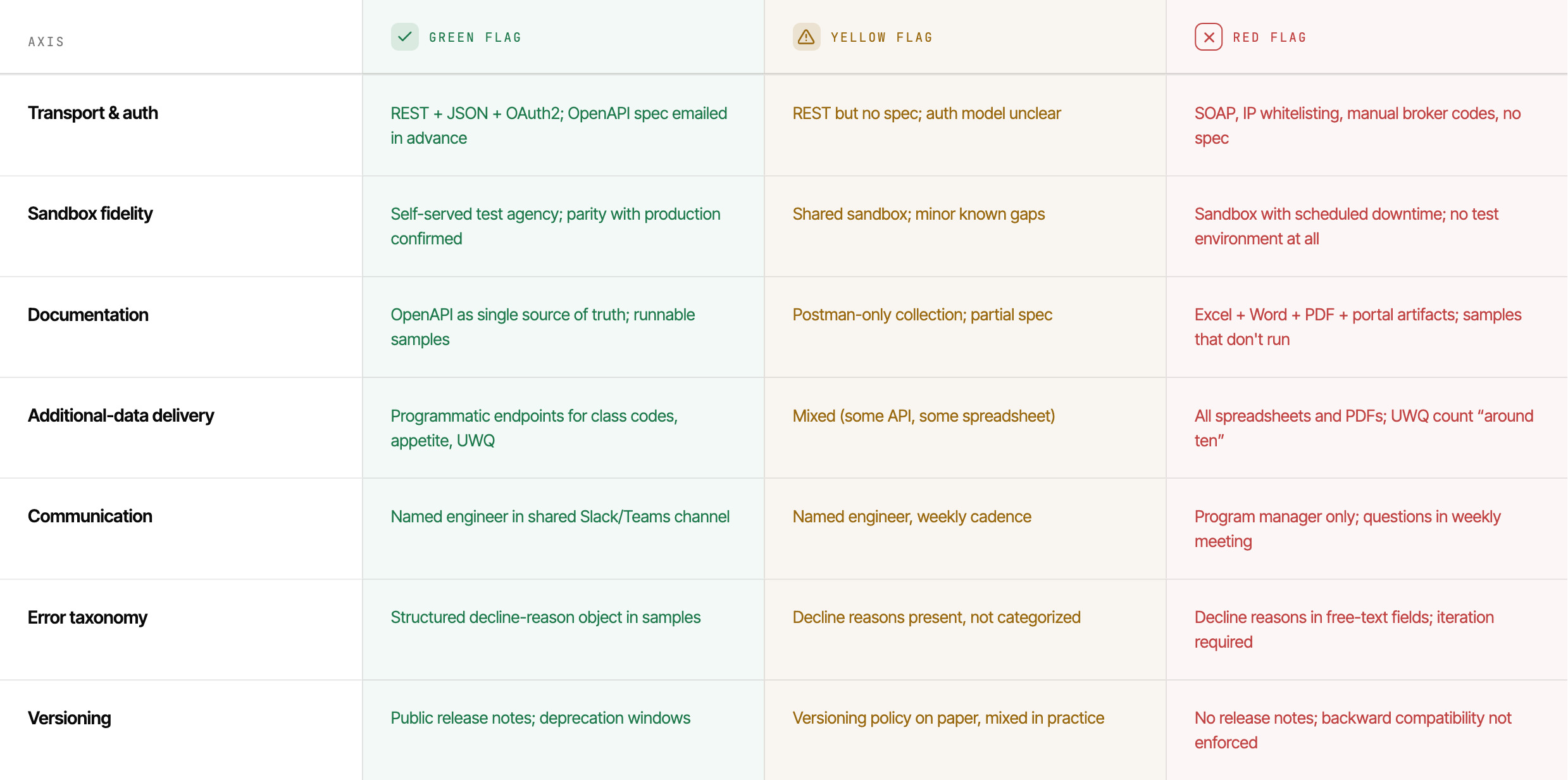
Across nearly thirty live carrier integrations, the best predictor of integration pain isn't carrier size or engineering experience. It's how the carrier's API surface scores on a small number of axes we can usually read in the first technical meeting.
The rubric doesn't make a hard integration easy — every integration is a multi-month commitment, even with perfect documentation. What the rubric does is surface, in week one, where the next eight to twelve weeks of unplanned discovery are coming from.
The seven axes
1. Transport & auth
The green-flag answer is REST + JSON, a published OpenAPI spec, OAuth2 with refresh tokens, and broker-code provisioning that's either self-served via API or backed by a clear SLA. What we see is a wide spread — REST, SOAP, XML, JSON, GraphQL, and the occasional flat-file or PDF intake; OAuth, custom token exchanges, mutual TLS, IP allowlists, and portal-cookie hybrids; broker-code models that range from self-served APIs to manual approval, one agency at a time, forever. Within a single carrier, different lines of business often run on entirely different APIs. This read is the first thirty seconds of the kickoff call, and it sets the floor on everything else.
2. Sandbox fidelity
A high-scoring carrier ships a sandbox that mirrors production — parity on minimum premiums, appetite rules, and class-code data; reasonable uptime; a self-served path to a test agency. We've seen the opposite too. Some test environments run with multi-hour daily downtime windows. Other sandboxes silently accept payloads production rejects, because the appetite and class-code data in prod aren't replicated in test. Some carriers don't enforce backward compatibility, so the contract you tested against on Tuesday quietly differs on Thursday with no version bump. Sandbox fidelity determines whether your testing actually means anything.
3. Documentation quality & accuracy
The green-flag answer is an OpenAPI spec that compiles, sample payloads that run against the live API on the first try, and a single source of truth. What we've seen instead: Swagger specs with broken $ref pointers and missing schemas. Sample payloads where the documented date format was reversed from what the API actually required — caught only when quotes started silently declining. A documented exposure field that turned out to be the wrong field entirely. A carrier that told us mid-build that the API wasn't the source of truth after all, and to "use this Excel sheet" instead. This is one of the two highest-impact axes — documentation quality is the single best predictor of how much of the carrier's job your team is going to end up doing.
4. Additional-data delivery (class codes, appetite, UWQ)
The integration isn't just the quote API — it's the apparatus that converts whatever the carrier has (class codes, appetite, underwriting questions) into a structure your platform can use. The green-flag answer is programmatic endpoints, versioned and paginated. What we've seen instead: an Excel workbook for class codes; a Word doc for UWQs; a PDF for appetite. UWQ catalogs that arrive shaped like a list and behave like a graph. APIs that return tens of thousands of class-code-and-state combinations one at a time, with no bulk endpoint, on servers that don't always stay up for the full pull. The other highest-impact axis, routinely missed in build estimates. If the carrier ships this data as a spreadsheet, your team is building the converter — and the converter is real software.
5. Communication
A named technical contact who actually built the API. A Slack Connect or Teams channel. Response latency in hours, not weeks. The best carriers put their engineers in a shared channel — we ping a specific person about a specific endpoint and resolve in hours. The worst answer integration questions only in a weekly thirty-minute meeting, where every unblocker carries a five-day minimum wait. Frequently, the person on the call is a program manager, not the API's actual author. They guess at answers, and the integration pays for the guesses. The delta between Slack-tier and weekly-meeting-tier communication is worth two to four weeks on a typical integration.
6. Error taxonomy & decline reasons
The green-flag answer is a structured decline-reason object that separates out-of-appetite from premium-below-minimum from UWQ-validation from data-validation errors. What we've seen instead: every carrier expresses declines differently, and the shapes look right until you parse them. Some carriers ship reasons as free-text English requiring string-matching. Some carriers split reasons across multiple response fields that have to be assembled. Some carriers return reasons buried inside what looks like a successful quote response. We've built a carrier-by-carrier decline-reason normalization layer because no two carriers ship the same shape.
7. Versioning discipline & change notification
Semantic versioning. Release notes. Advance notice of breaking changes. A deprecation window. What we've seen instead: most carriers ship changes without announcing them. NCCI codes update mid-quarter. Underwriting questions get added or moved between payload groups. Payload shapes shift. The first signal anyone gets is the response to whatever the agent just submitted. One carrier we integrate with decommissioned its traditional BOP product entirely and forced every customer to migrate. This is the axis most predictive of ongoing maintenance load, not initial build time. A low score here doesn't make the integration take longer to ship — it makes the integration cost more every month after it ships, forever.
How to read the rubric in the kickoff call
Most of the rubric reads in the first technical meeting. Some signals are obvious; others require listening for what isn't said.
What the rubric tells you about timeline
A high-rubric carrier, integrated by a competent in-house team starting from scratch, is a fourteen-to-sixteen-week build. That's not a low number — it's an industry-honest one. CoverForce ships the same carriers in eight to ten weeks because we've absorbed the cost upstream — canonical schema, retry/idempotency infrastructure, IP-allowlist proxy, UWQ engine, decline-reason normalization, all built carrier by carrier over years. The rubric transfers the diagnosis, not the ramp.
A low-rubric carrier doesn't shift the build by one or two weeks. It extends discovery alone to eight to twelve weeks before serious code is written. Documentation gaps become customer-facing declines. Missing data delivery becomes a parallel data-ops effort. Weak versioning becomes a perpetual monitoring tax. None of it shows up as a missed deadline.
Documentation quality and additional-data delivery are the two axes most predictive of total spend; versioning drives ongoing maintenance; communication quality decides whether discovery takes four weeks or twelve.
The view from the other seat
The same seven axes look very different from inside a carrier. Sandbox fidelity is the leading indicator of false declines in your customers' traffic — integrators discover the gap in your end customers' submissions, not in their own test environment. Documentation and data delivery are recruiting taxes; every Excel workbook shipped in lieu of a spec adds weeks to every integration partner you'll ever have. Versioning discipline is the silent killer — the carriers we ship fastest with are the ones who tell us before they change a class code, not after. Communication quality is whether an integration ships in twelve weeks or twenty-four; the carriers scoring highest here are the ones whose engineers, not their program managers, are in our Slack channel. The companion series goes deeper on the prescriptive side; this rubric is the diagnostic on-ramp.
Close
If you're sizing a build and want a second read on a specific carrier, we've already scored every major commercial API in the market. The rubric above is the one we use internally; the eight-to-ten-week integration timeline we ship at is the product of work we've already done. If you want to know what you'd actually be walking into on a given carrier, we're happy to share what we found.
.png&w=1920&q=75)