Most integration stories end at "we got a quote back." The demo lands, the screenshot goes into a deck, the steering committee nods. The hard half of the integration starts on the next click.
Bind, payment, and document delivery is where commercial-insurance integrations earn their keep — and where most in-house builds underestimate what they signed up for. Quote is a read. Bind is a write that moves money, creates a legal document, and entangles state across at least two systems. Payment is regulated. Documents are asynchronous. None of that surfaces in a quote demo.
Why this layer is different from quote
Quote APIs are forgiving. The contract is stateless from the carrier's perspective — same input, same output, no side effects. If a quote response comes back wrong, you re-quote.
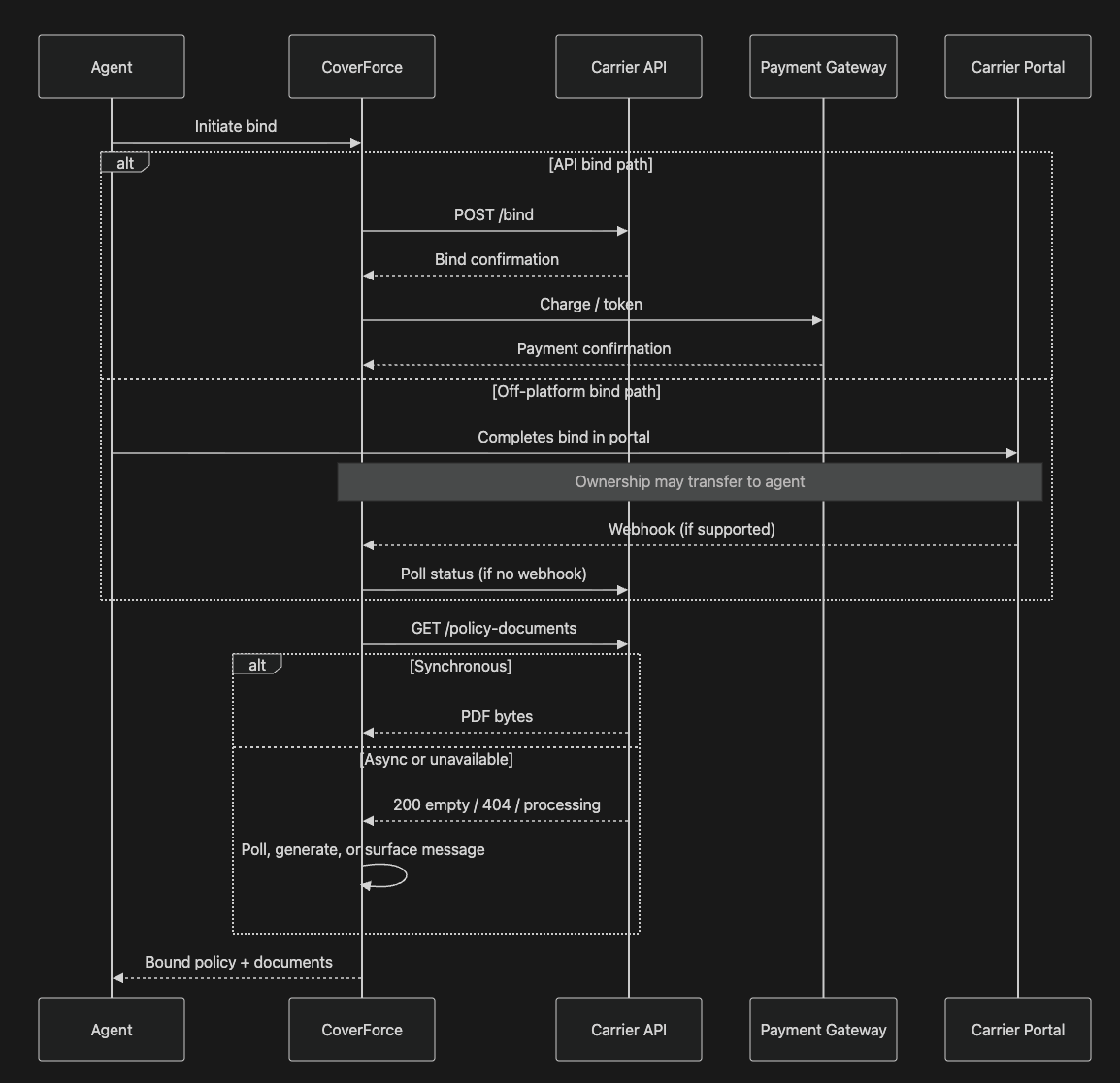
Bind is not that. A bind succeeds or fails across multiple systems at once: your platform, the carrier's policy admin system, a payment gateway, sometimes the carrier's portal, and eventually a documents service that you do not own and that runs on a different clock. Each of those can disagree with the others. Reconciling them is the integration.
This is the structural shape of the work, and it does not show up in any "we integrated with N carriers" headline.
Bindable quote vs. indication
The first thing every in-house integration plan glosses over is the difference between an indication and a bindable quote.
An indication is a number. A bindable quote is a contract the carrier will stand behind if you exercise it — which means by the time the quote comes back, the entire submission, every underwriting question, every class-code dependency, every state-specific surcharge, has already been resolved cleanly enough that the carrier will commit. We covered why underwriting questions alone make this hard in Part 6.
Many integrations cut this corner — they get a number back and call it done. That works until an agent tries to bind, the carrier rejects the submission for a reason that should have surfaced at quote time, and the agent watches a "bound" indicator flip back to "needs review." Bindable-by-default is a much higher engineering bar than it sounds, and it touches every layer of the integration stack we walked through in Part 5.
Bind state lives in systems you don't control
Here is the part that is hardest, and that we keep watching teams discover the expensive way: bind state does not live in one place.
A bind can happen one of three ways: entirely through the carrier's API, entirely through the carrier's portal, or via a submission that crosses between the two mid-flow. Which path an agent takes depends on the line of business, the agency's preference, or whether the submission needs an off-platform endorsement first. The same integration has to handle all three shapes at once:
- API bind — our system initiates, our system knows the answer.
- Off-platform bind — the bind happens in the carrier's portal. Our system finds out later, or doesn't.
- Reconciliation back to our platform — billing, commission tracking, document delivery, and agency reporting all need the bind status, regardless of which path produced it.
For off-platform binds, the carrier either supports webhooks or it doesn't. When they do, reconciliation becomes a fan-out problem: a single carrier policy can map to multiple submissions on our side, and each webhook event has to update all of them in one transaction. When they don't, we fall back to polling — a search-by-business-name endpoint, a daily reconciliation job, a cron nobody enjoys maintaining. And the webhook story across the industry is still uneven; we've seen one carrier ship their first off-platform bind webhook only in 2026.
Payment is its own surface
The bind call is rarely the end of the bind. For most carriers, payment is a separate flow with its own topology. We have integrated all of these shapes:
- Carrier-direct API payment — pass card or ACH details through the carrier's payment endpoint. PCI scope is yours.
- Browser redirect to a payment gateway — some carriers route the agent through their own gateway. The integration is no longer API-only; the agent portal has to hand off cleanly and come back to the right place.
- Deferred payment — bind happens, payment doesn't, billing chases the insured later. No payment surface at bind time, but reconciliation still has to know.
- Third-party payment processors — Stripe and others, with their own retry, idempotency, and webhook semantics layered on top of the carrier's.
Inside any of these shapes, the same engineering rule holds: money movement needs idempotency. A retry on a bind that has already drawn down a payment authorization is the kind of bug that does not show up in testing and does show up in a customer's email to the broker. Single-use tokens, idempotency keys, and reconciliation windows are not optional — and each carrier expresses them differently.
A multi-tenant agent portal has to support every one of these payment paths at the same time, configurable per carrier, with consistent UX. That work alone is multi-quarter for an in-house team building it from scratch.
Documents are asynchronous, occasionally absent, and need their own infrastructure
Documents are slower, less reliable, and less standardized than quote. Some carriers generate a proposal PDF synchronously. Some take hours. Some don't generate one at all for certain submission paths and expect us to bridge the agent to a carrier portal instead. Policy documents and endorsements run on their own clocks, and PDF size limits are usually undocumented until the day a large ACORD upload triggers a 502.
Because the surface is this varied, document handling cannot be a thin wrapper. It needs availability detection, retry, polling fallbacks, in some cases proposal generation on our side when the carrier does not provide one, and a normalized "the doc is ready" signal for the agent portal regardless of which path produced it.
The ops layer no one budgets for
A quote is one row in a table. A bound policy with documents delivered is a state machine: created → quoted → bindable → bound → paid → policy-issued → documents-available → reconciled. Every state can fail forward or fall back. Every transition needs to be observable.
We have a war story for almost every transition. Two carriers, two different shapes, same fortnight. On the first, an agent finished bind in the carrier's own portal — the legitimate path for that submission — and our subsequent API call to read policy status came back 403, because portal login had transferred submission ownership away from our API partner key. On the second, the quote-proposal endpoint returned a 200 with zero bytes for a Bridge submission, and the agent's "Download Proposal" button delivered a blank PDF until our adapter learned to detect empty bodies and surface a real message.
Neither of those were carrier defects, exactly. They were carrier behaviors that an integration has to know about, detect, and translate into something the agent and the downstream systems can act on. That detection-and-translation layer is the actual product of an integration platform. We'll go deep on the monitoring framework that makes it visible in Part 9.
Where this lands
If "bindable quotes, well-documented document APIs, and webhook-driven bind reconciliation" sounds obvious, it is — and it is also the half of the integration that is hardest to build twice. The state machine that reconciles bind across an API, a portal, a payment gateway, and a documents service is not a feature. It's a permanent ops surface with engineering attached, and every additional carrier multiplies the number of shapes it has to handle. CoverForce ships all three across 30+ carriers; the work of running that state machine becomes ours.
For the full lifecycle, see Anatomy of a Carrier Integration.
.png&w=1920&q=75)
.png&w=1920&q=75)