
You shipped the integration. The agents are quoting. Bind volume is climbing. Somewhere, very quietly, the integration is already starting to break.
That is the part of carrier connectivity nobody warns you about up front. The build is finite. The decay is permanent. And the carriers will not tell you when something has changed — not always because they're hiding it, but because most of them don't have the release-note discipline to tell you in the first place.
This is Part 9 of our series on the hidden cost of carrier connectivity. For the full lifecycle, see Anatomy of a Carrier Integration.
What "silent change" actually means
Across our integrations we see three flavors of silent change in production, every month, on a steady rotation.
A class-code dictionary drifts. The carrier's catalog of in-appetite NCCI or carrier-internal codes shifts — a code is added, removed, remapped to a different description, or picks up a new state restriction. The carrier's runtime starts rejecting quotes that used to bind. Your reference table doesn't know.
A UWQ catalog drifts. A new required underwriting question appears on a line of business. An existing question's applicability changes — different class codes, different states, different revenue tiers. A question's allowed answer types tighten (a NUMBER that used to accept 12.5 now insists on integers). Your model didn't get the memo.
A request-payload shape moves. A question that lived under one payload group last week now lives under a different group; a field that was optional becomes required; a dependency between two questions is introduced. The carrier rejects the parent question, the child questions error as missing data, and the failure response looks, on the wire, like nothing the carrier did.
A small minority of carriers do publish release notes. Liberty Mutual and Markel are the two we point to: both ship monthly notes ahead of state rollouts and class-code updates, and even with the notes, the work is monthly. Every other carrier in our experience ships changes without announcement — and across our integrations we see about 20–25% of them flip every month. The integration is not a project. It is a subscription.
Why the response always looks like a customer problem
The hardest part of a silent change isn't the change. It's the response.
A carrier silently tightens appetite, and the API returns a clean decline. Your decline-taxonomy maps it to "class code not in appetite." The agent sees a decline. The agent moves on. The signal that the carrier's world changed is buried inside what looks like a customer's request being declined.
There is no feed to subscribe to. There is no version-bump header. There is no 204 Schema-Changed heartbeat. There is only the response to whatever the agent just submitted, looking exactly like every other decline you've ever seen. Detection is inference, not subscription.
Three variations of the same shape we've watched across three different carriers, none of which shipped a line of release notes:
On a Workers' Comp carrier, eligible quotes started declining as "class code not in appetite" — except the carrier's own valid-class-codes endpoint said the codes were in appetite. Our internal class-code table had drifted out from under the carrier's dictionary, and the same root cause surfaced more than once before we ran it down to the table-level mismatch. The decline read as ordinary. The contradiction was the tell.
On a separate WC carrier, quotes began returning a generic system error during rating. The response was indistinguishable from a real underwriting decline until our decline-pattern monitoring flagged a specific catalog of submissions failing in a tight cluster — same NAICS, same state, same shape, all in a window of a few days.
And on a CGL line at a third carrier, an underwriting question silently moved between payload groups. The carrier rejected the parent, three child questions errored as "missing data," and the failure looked, from the response alone, like a buggy submission rather than a schema change. It wasn't.
None of these were announced. All three were caught by monitoring, not by reading the carrier's docs.
The monitoring framework we actually run
The framework is less abstract than it sounds. On any given Monday morning, the discipline is to monitor every FAILED quote and every DECLINED quote — and to treat them differently because they tell us different things.
FAILED is the easy half. A failed quote is, by definition, something we could not classify into a clean outcome — a 5xx from the carrier, an auth-token expiry, a payload validation we didn't anticipate, a retry that exhausted. We investigate every one. The triage is mechanical, the signal is loud, and the bar for "did our integration just break" is whether the failure rate moved.
DECLINED is where the discipline lives. A clean decline looks identical on the wire whether the agent submitted a genuinely ineligible risk or the carrier silently shifted their class-code dictionary out from under us. The work is figuring out which one you are looking at — and we don't do that by hand. We built systems for it.
Every decline gets classified through a layer that cross-checks the carrier's own appetite and UWQ endpoints (where they exist), the prior decline-reason taxonomy we've assembled for that carrier and LOB, and the literal reason text the carrier returned. A decline that contradicts the carrier's own appetite endpoint is the loudest signal we have that something has moved. A decline whose reason text suddenly diverges from the pattern for that NAICS-and-state is the next loudest. Most of this runs on the error-classification layer we described in Part 5 as Layer 4 — the boundary between "carrier-side problem" and "customer-side problem." The classifier is the boundary made operational.
The gradient is the real signal. A single decline tells you nothing. A decline rate that creeps up over days or weeks for a carrier-and-LOB combination tells you something. Either the carrier is quietly tightening appetite — in which case nobody told us, and we should reflect it in our agent UX — or the carrier silently changed something — in which case nobody told us, and we should fix it. Both demand the same first action: figure out what changed.
All of that is the daily discipline. Underneath it sit the per-layer alarms from Part 5, the production canaries from Part 7, and the bind/payment/document alerts from Part 8. They matter. They are not what catches a silent change. The FAILED/DECLINED/gradient triad does. The rest is plumbing.
Inline diagram placeholder — detection loop
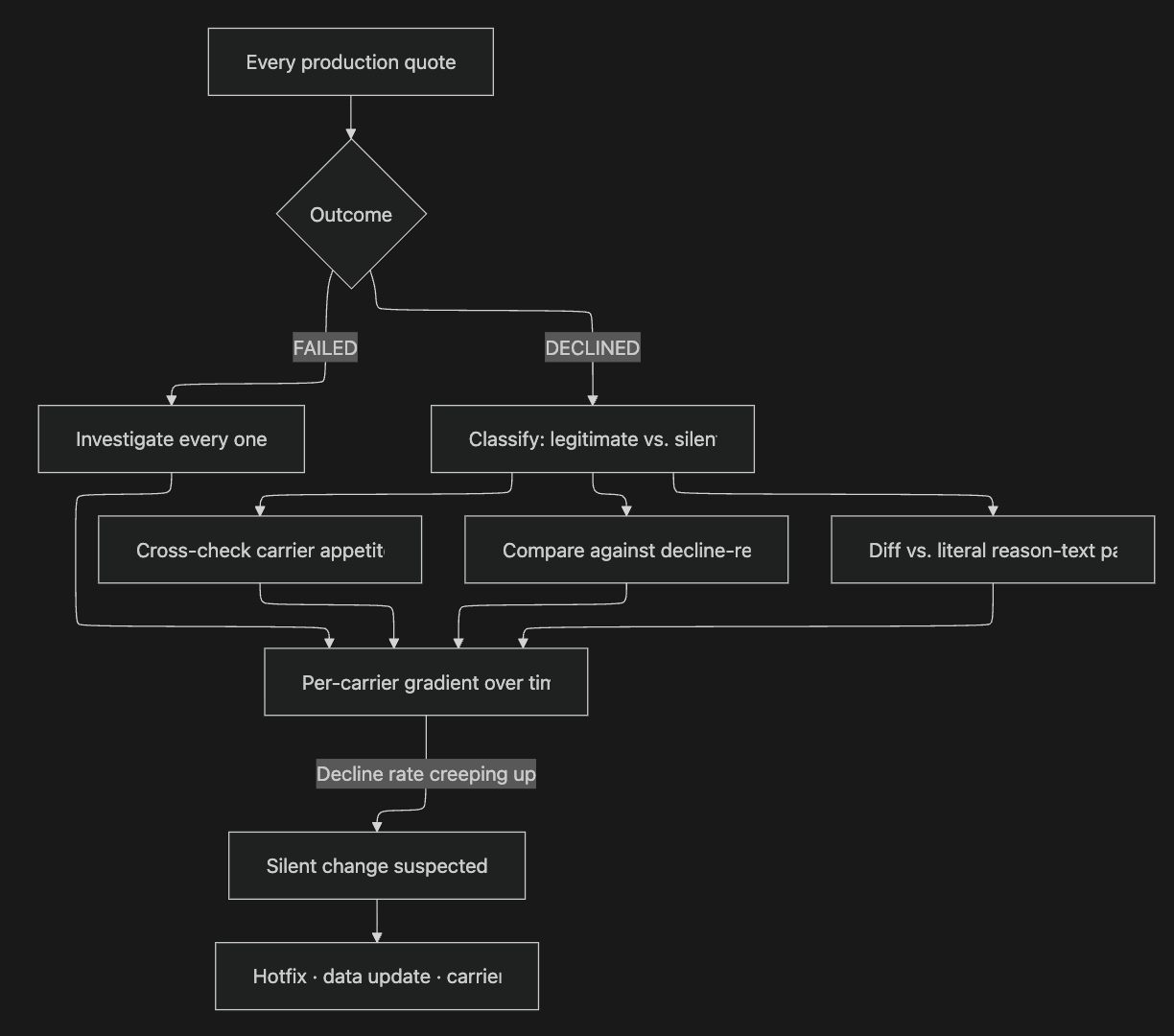
Detection is inferred from production traffic — no feed, no changelog.
Their underwriting logic, your code
The other thing nobody warns you about is the boundary blur.
Some carriers will ship an appetite endpoint but not enforce it. Some will return a fully priced quote and expect you to decline it if the class code is out of appetite or the premium falls below their minimum. We have lived through both. Once you've built that enforcement into your stack, you own their underwriting logic — and you own the maintenance of it the next time their minimum changes, or their appetite shifts, or their decline rules acquire a new exception nobody documented.
This isn't monitoring. It is a permanent carrier-relations function with engineering attached. It is structurally invisible in an in-house build estimate, because it isn't your logic — it is logic the carrier didn't ship that you built on their behalf, and that they can revise without ever opening a ticket on your roadmap.
And then the carrier walks away
There is one final form of silent breakage we do not see often, but when we see it, it is final.
Carriers occasionally migrate or decommission entire product lines. Liberty Mutual moved traditional BOP to CPSP and every customer migrated. Other carriers have walked away from a product line overnight, leaving integration partners with a live API surface and zero appetite. A fully built integration to a discontinued product is a fully built asset that goes to zero.
The carriers who publish monthly release notes are sometimes the same carriers who can still pull a product line without warning. Communication discipline on day-to-day changes does not always predict communication discipline on strategic ones. You will not know until you start seeing every quote decline.
The cost the build estimate doesn't carry
If you are evaluating an in-house build of carrier connectivity, the monitoring and detection layer is the cost almost no estimate includes. Engineering teams budget for the integration. They do not budget for the system that runs underneath the integration, every day, watching every decline for the signal that the carrier's world has shifted. They do not budget for the boundary-blur work where the carrier's missing logic becomes your code. They do not budget for the day a product line goes to zero.
Across 30+ carriers and 60+ live integrations, the silent-breakage tax is the single largest line item we pay. We have built the classifiers, the gradients, the canaries, and the per-carrier dashboards to detect what no changelog will tell us. The answer is the same every month: the integration that worked yesterday will need work today.
This is the cost no spreadsheet model carries — because it doesn't look like engineering work on the budget line. It looks like decline data, until you build the layer that turns decline data into a signal. CoverForce has built that layer once, against every carrier in our portfolio. One integration into the abstraction layer, and the detection-and-response loop becomes ours.

.png&w=1920&q=75)
.png&w=1920&q=75)