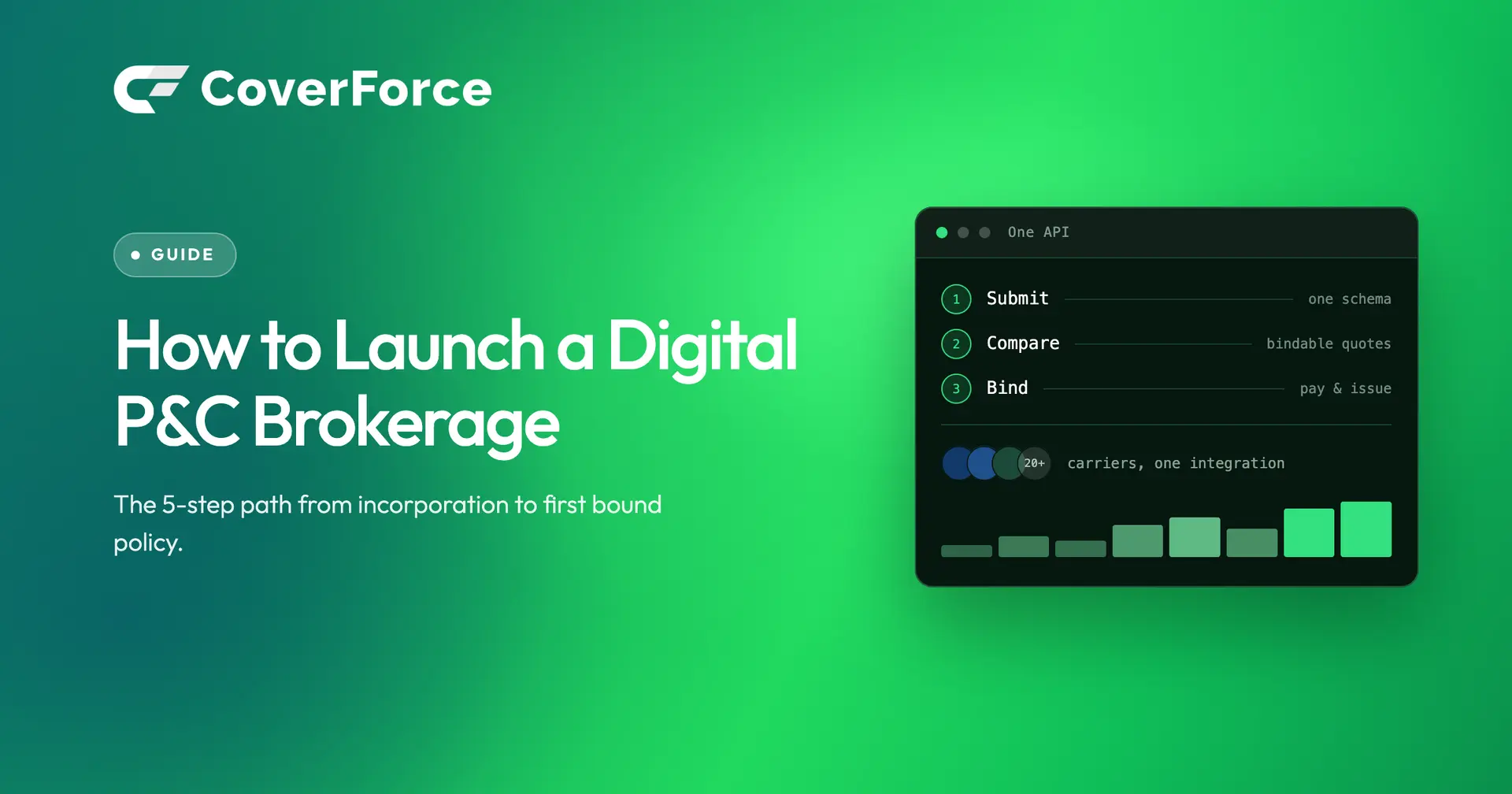
If you're a founder building a digital P&C brokerage, the path to going live is more complicated than it looks. Done right, you're bound and writing in 6–9 months. Done wrong, you're 18 months in and still chasing your third carrier appointment.
The difference is sequencing. There are five steps between incorporation and your first bound policy. Each one is a real gate. But the work inside several of them runs in parallel, and founders who treat the five steps as five sequential queues add months of runway they didn't need to spend.
Here's the full sequence: what each step requires, how long it takes, and what it gates.
.png)
Step 1: Set up Your Entity
Before anything else, the brokerage needs to have a legal entity that can hold licenses, sign appointment agreements, and accept commissions.
What you need:
- LLC or corporation. Most insurtechs incorporate as a Delaware C-Corp for fundraising reasons, then register to do business in their home state.
- Federal EIN from the IRS
- Business bank account
- Registered agent in the state of formation
Timeline: 1–2 weeks if you move quickly. Delaware formation is same-day; foreign qualification in your operating state takes a few days to a couple of weeks depending on the state.
Get this right on day one. Carriers, wholesalers, and regulators will all ask for the documentation, and a messy entity structure surfaces at the worst possible moment, usually mid-appointment review.
Step 2: Get Licensed
This is the longest step and the one that gates everything downstream. It has four components, and two of them run in parallel from day one.
The individual producer license (30–60 days)
Your entity license requires a designated licensed individual, usually a founder. That person needs their own resident P&C producer license first.
- Pre-licensing education (course hours vary by state, typically 20–40 hours for P&C)
- State licensing exam (P&C combined, or Property and Casualty separately, depending on the state)
- Background check and fingerprinting
- Application through NIPR (National Insurance Producer Registry)
Start the coursework the week you incorporate. This step is almost entirely paced by how fast you finish the hours and get an exam slot.
E&O, GL, and surety bonds (1–3 weeks, runs in parallel)
Coverage has to be bound before the entity license can be filed (most states require proof of E&O at the time of application) and before any carrier or wholesaler will open an appointment conversation.
- Errors & Omissions: required across the board. Carrier minimum limits typically exceed state minimums, so quote to the carrier requirement, not the state floor.
- General liability: not universally required. Some carriers and wholesalers require it as part of onboarding; others don't. Confirm with the specific partners you intend to work with. Usually bundled with E&O or a BOP when needed.
- Surety bonds: required by some states for licensure and by certain carriers or wholesalers, but not universally. Face values vary by state and partner.
New agencies sometimes get pushback from E&O underwriters on no-history applications. A founder with prior insurance experience helps.
The entity license (30–90 days)
With the producer license and E&O in place, the brokerage itself applies for a producer license as a business entity in its home state. This is the gate. Once it issues, Steps 3 and 4 can complete and non-resident filings can go through.
- Designated Responsible Licensed Producer (DRLP): the individual licensed above. Terminology varies by state.
- Entity application through NIPR
- Proof of E&O coverage
- State filing fees
Non-resident licenses (~1 quarter for ~20 states)
Every state where a policy will be bound requires its own license. Once your home-state entity license is active, you can file non-resident applications via NIPR for each target state.
Most approve in 2–6 weeks. A handful are slower, and some states require additional filings. Plan on a full quarter to be fully licensed across a 20-state footprint.
Step 3: Access the Market
A license lets you sell. Appointments determine what you can sell. No new brokerage gets appointed directly by every carrier it wants to write, so there are two paths, and most digital brokerages use both.
Direct appointments. The carrier signs an appointment agreement with you directly. Realistically that's one to three carriers in year one, and only if a founder brings relationships or pedigree. Carriers will ask about projected premium, distribution model, target classes, and loss history. With no history, founder background carries most of the weight. Expect 2–6 months per carrier, and expect some to say no.
Partner market access. You write through someone else's appointments: a wholesaler, an agency network, or an established retail broker willing to be the bridge for a scratch agency in exchange for a commission share or fee. Faster and broader, but the partner takes a piece. Wholesalers are the norm for E&S business, hard-to-place risks, and any line where direct appointments are gated.
The practical answer for most launches: direct appointments with one or two strategic carriers where the economics and the relationship justify the wait, plus partner access for the rest of the panel. Start these conversations while the entity license is pending. They take weeks to set up once you can produce a license.
Step 4: Connect the API
Appointments give you the right to sell. Integrations give you the ability to actually quote and bind without sitting inside carrier portals re-keying data. These are two separate stacks. Keep them separate as you plan.
Building direct integrations in-house. The first hurdle is access: most carriers won't provide API access to net-new brokers at all. Direct connectivity is generally reserved for brokerages with established premium volume, loss history, and a track record carriers can underwrite against.
Even when you do get access, each carrier integration takes 6–9 months to build properly. Three engineers can run roughly six integrations in parallel for a single line of business. A 5-carrier, 3-LOB launch is 15 carrier-LOB integrations, which is 24+ months of build work before you write a single policy. And the build is the easy part. Carriers ship 3–5 significant API changes per year, every year, forever, and every one of them is maintenance you now own.
Connecting through an API aggregator. One integration gives you the entire connected carrier network, provided you already have appointments (direct or via partner) with the carriers in it. CoverForce is the leading commercial insurance API marketplace in the US, with 30+ pre-integrated carriers across six lines of business, totaling 60+ integrations. For a brokerage at launch, it's the only path that turns a multi-year integration roadmap into weeks of work.
Timeline: 12–24+ months to a useful panel if you build, assuming you can secure API access at all. Days to weeks with CoverForce, depending on your deployment format.
Step 5: Quote Yor First Risk
Licensed, bonded, appointed, integrated. Writing policies.
"Operational" is not a status you declare. It's a transaction that completes. A real submission flows in, gets quoted across the appointed panel, gets bound with a real carrier, generates a real commission, gets recorded in a real agency management system, and gets serviced through renewal. Every one of those has to work end to end before launch is real rather than theoretical.
Realistic target: month 6 to month 9 from incorporation.
The Bottom Line
Every founder gets the same 9 months of runway between incorporation and first policy. The ones who spend it on the quoting experience and the underwriting logic — not on licensing logistics and carrier plumbing — are the ones who have a product when they go live.
The startups that win aren't the ones that built the most. They're the ones that spent their build on the right things.
Building in this space? If you're a startup launching a digital P&C brokerage and want to compress the connectivity timeline from years to weeks, get in touch with the CoverForce team.
Disclaimer: The information in this article is provided for general informational purposes only and does not constitute legal, compliance, or financial advice. Licensing requirements, bonding amounts, and regulatory terminology vary by state and change over time. Consult a licensed attorney, compliance professional, or your state's Department of Insurance before taking action.
.png&w=1920&q=75)
.png&w=1920&q=75)