.png&w=1920&q=75)
A Founder's Guide to Commercial Lines: What Each Policy Covers and Who Writes It
Commercial insurance is not one product. It's a set of distinct lines, each covering a different category of business risk, underwritten by different carriers, and purchased by different buyers for different reasons.
If you're building a digital brokerage, knowing the landscape is foundational.
Before diving into the details of each line, it's worth understanding how the market is sized. Commercial Property, Commercial Auto, and Workers' Comp are the three largest lines by earned premium — each in the $60–$104B range. BOP, General Liability, and Inland Marine sit in the next tier. Specialty lines like Cyber, Surety, E&O, and the Management Liability components are smaller in aggregate premium but often carry higher commission rates and faster growth trajectories.
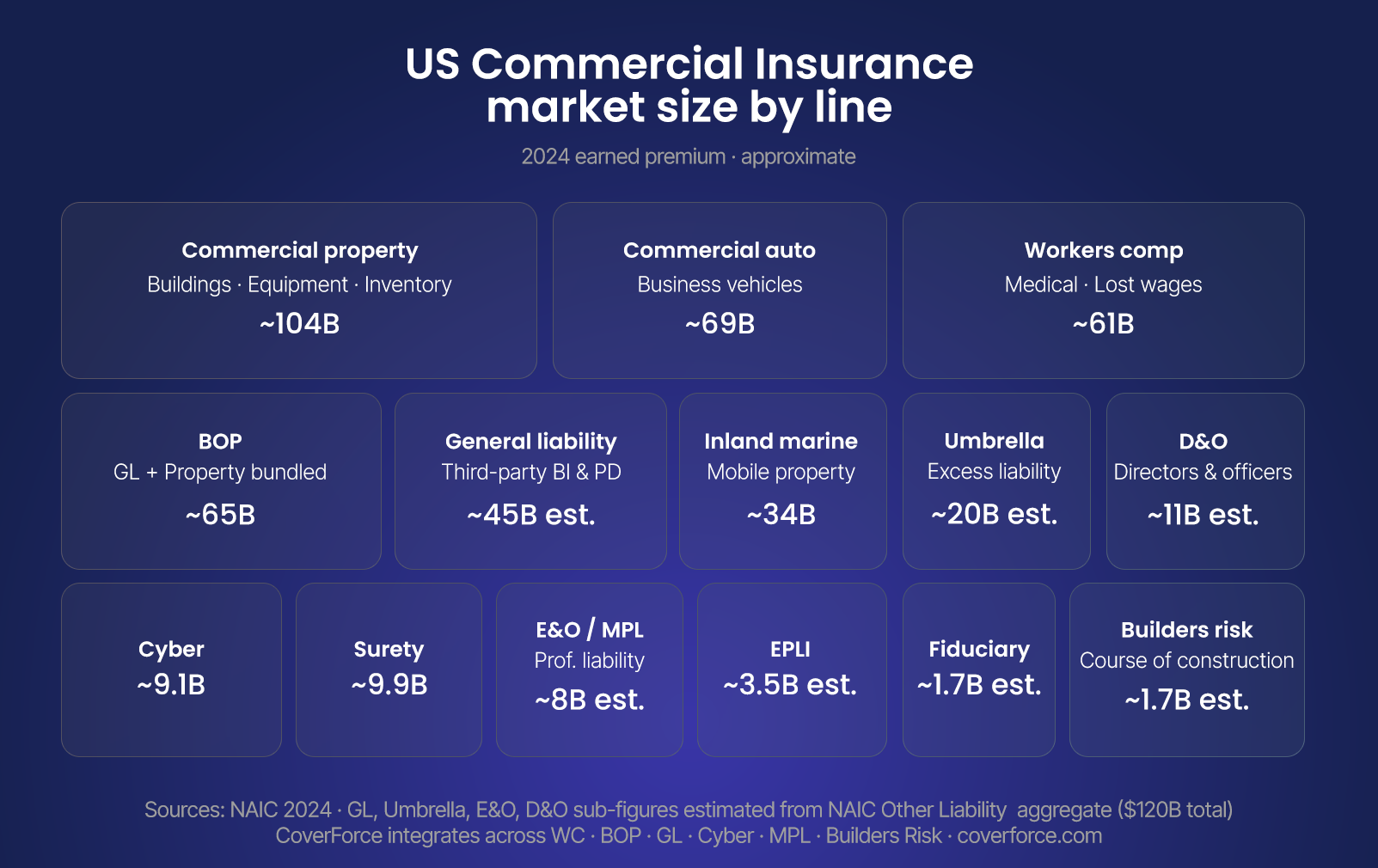
The diagram above is sized to scale by 2024 earned premium. A few figures — GL, Umbrella, E&O, and D&O — are estimated from the NAIC's Other Liability aggregate ($120B total), which doesn't break these out as separate statutory lines. Everything else is sourced directly from NAIC 2024 data.
Here's what each line covers, how it's distributed, and who the major carriers are.
Business Owner's Policy (BOP)
A package product that bundles General Liability and Commercial Property into a single policy. Designed for small to mid-size businesses — retail shops, restaurants, service businesses, contractors. Because it combines two coverages into one, it's typically the first and only commercial policy a small business buys. Businesses that outgrow BOP limits purchase GL and Commercial Property separately.
New business commission: 12–20%
Major carriers: The Hartford, Travelers, Liberty Mutual, Hiscox, Markel, Chubb.
Relevant verticals: Retail, food service, professional services, light contracting.
General Liability (GL / CGL)
Covers third-party bodily injury and property damage arising from business operations. The baseline policy for virtually every business — required by landlords, vendors, and licensing bodies before any other coverage. Often included in a BOP for small businesses; purchased standalone when property coverage isn't needed or when limits exceed BOP capacity.
New business commission: 10–15%
Major carriers: Travelers, Chubb, The Hartford, Liberty Mutual, Markel, Hiscox, Employers.
Relevant verticals: Nearly universal — contractors, retail, restaurants, professional services, events.
Commercial Property
Covers physical assets — buildings, equipment, inventory, and contents — against loss from fire, theft, weather, and other perils. Often included in a BOP for small businesses; purchased standalone when property values exceed BOP limits or when the business owns real estate outright. Coastal and wildfire-exposed risks are increasingly moving to surplus lines markets as admitted carriers pull back from catastrophe-exposed geographies.
New business commission: 10–18%
Major carriers: Travelers, Chubb, Zurich, FM Global, Markel, and Lloyd's syndicates for specialty or high-value risks.
Relevant verticals: Retail, manufacturing, real estate, warehousing, hospitality.
Workers' Compensation (WC)
Covers medical expenses and lost wages for employees injured on the job. Mandatory in most states the moment a business has W-2 employees. Premiums are calculated as a rate per $100 of payroll, applied by job classification — so the same payroll can produce dramatically different premiums depending on what the employees actually do.
New business commission: 7–12% (lowest in commercial lines)
Major carriers: Travelers, The Hartford, AmTrust, ICW Group, Employers Holdings, GAIG.
Relevant verticals: Universal for any business with W-2 employees — construction, healthcare, manufacturing, retail, staffing.
Note: In four monopolistic states — North Dakota, Ohio, Washington, and Wyoming — WC must be purchased from the state fund. Private carriers cannot write it.
Commercial Auto
Covers vehicles owned or operated by a business in the course of operations. Any vehicle used commercially — contractor vans, delivery trucks, company cars, food trucks — needs Commercial Auto; a personal auto policy won't respond to a commercial loss.
New business commission: 10–15%
Major carriers: Progressive, Travelers, Sentry, Zurich, Great West Casualty (trucking), National General.
Relevant verticals: Contractors, trucking, delivery, food service, field service businesses.
Commercial Umbrella / Excess Liability
Provides additional liability limits above the underlying GL, Auto, or WC policy — activated once the underlying limit is exhausted. Typically required by contract for contractors, businesses with large fleets, or any operation where $1M in GL limits isn't enough to satisfy a client or landlord.
New business commission: 10–15%
Major carriers: Travelers, Chubb, Markel, Nationwide, Philadelphia Insurance Companies (PHLY), W.R. Berkley.
Relevant verticals: Contractors, manufacturing, transportation, any business with high-limit contract requirements.
Cyber Liability
Covers losses from data breaches, ransomware, and other cyber incidents — including breach response costs, regulatory fines, business interruption, and third-party liability. Increasingly required by contract for any business handling customer data, and effectively mandatory for technology companies and healthcare providers.
New business commission: 15–25% (highest in commercial lines)
Major carriers: Chubb, Beazley, Coalition, At-Bay, AXA XL, Travelers, Hiscox, Tokio Marine HCC.
Relevant verticals: Technology companies, healthcare, financial services, any business with significant customer data.
Miscellaneous Professional Liability (MPL) / Errors & Omissions (E&O)
Covers financial losses a client suffers due to errors, omissions, or negligence in professional services. General Liability doesn't cover this — if a consultant gives bad advice or a software product fails, GL won't respond. MPL will. Purchased by consultants, technology companies, staffing firms, real estate professionals, marketing agencies, and any business where the deliverable is advice or a service.
New business commission: 12–18%
Major carriers: Hiscox, Travelers, Chubb, Markel, Berkshire Hathaway Specialty Insurance (BHSI), Tokio Marine HCC, GAIG.
Relevant verticals: Technology, consulting, staffing, real estate, marketing, architecture, engineering.
Managemnt Liability
Management Liability is a suite of coverages that protects a company's directors, officers, and the organization itself against claims arising from management decisions and corporate governance. The three components below are frequently packaged together, particularly for mid-market and enterprise buyers, though each can be purchased standalone.
New business commission: 12–20%
Major carriers: Chubb, AIG, Travelers, Beazley, Hiscox, Markel, Berkshire Hathaway Specialty Insurance (BHSI).
Relevant verticals: VC-backed startups, mid-market companies, any business with a formal board or employee benefit plans.
Directors & Officers (D&O)
Covers corporate directors and officers against claims alleging mismanagement, breach of fiduciary duty, or securities violations. VC-backed startups typically pick this up at Series A — investor side letters frequently require it. Public companies carry it as a matter of necessity.
New business commission: 12–18%
Major carriers: Chubb, AIG, Berkshire Hathaway Specialty Insurance (BHSI), Markel, Travelers, Beazley, Hiscox.
Employment Practices Liability (EPLI)
Covers claims brought by employees alleging wrongful termination, discrimination, sexual harassment, or retaliation. Available standalone for employers with as few as one employee; frequently bundled into a Management Liability package for larger businesses. California risks are treated as a distinct underwriting category by most carriers due to the state's employment law exposure.
New business commission: 12–18%
Major carriers: Travelers, Chubb, Markel, Great American, Beazley, Hiscox, CNA.
Fiduciary Liability
Covers plan administrators, trustees, and the company itself against claims of mismanagement of employee benefit plans — 401(k)s, pension funds, health plans — in violation of ERISA obligations. Distinct from D&O: D&O covers corporate governance decisions; Fiduciary covers benefit plan administration. Relevant for any business offering employee retirement or benefit programs.
New business commission: 12–18%
Major carriers: Chubb, Travelers, Markel, Great American, Berkshire Hathaway Specialty Insurance (BHSI), Colonial Surety.
Inland Marine
Inland Marine is a broad line covering property that moves — tools, equipment in transit, fine art, tech hardware, and other assets that don't stay in one place. Despite the name, it has nothing to do with water; the term is a historical artifact. Inland Marine fills the gap that Commercial Property leaves: a fixed-location property policy doesn't respond when equipment is stolen from a job site or damaged in transit.
The construction classes within Inland Marine account for the highest premium volume in the line. The three most commonly purchased are listed below; the broader line also includes Equipment Floaters (any movable business equipment), Fine Art Floaters, Valuable Papers & Records, Accounts Receivable, and Instrumentalities of transportation and communication (bridges, roads, piers, TV/radio towers).
Major carriers: Travelers, Chubb, Markel, Liberty Mutual, Nationwide, and specialty markets through Lloyd's.
Relevant verticals: Construction, fine art dealers, technology equipment, transportation.
Builders Risk (Course of Construction)
Covers buildings and structures under construction against loss from fire, theft, vandalism, and weather. Technically a specialized form of Inland Marine, written on inland marine forms. Purchased for the duration of a construction project — coverage attaches at groundbreaking and terminates at project completion. Required by construction lenders on virtually every financed project.
New business commission: 10–15%
Major carriers: Zurich, Travelers, Chubb, Munich Re, AXA XL, and specialty markets through Lloyd's.
Relevant verticals: General contractors, developers, construction lenders, owner-builders.
Contractor's Equipment
Covers owned tools and heavy equipment — excavators, lifts, compressors — at job sites and in transit. Unlike Builders Risk, it is not tied to a specific project; it follows the equipment wherever it goes.
New business commission: 10–15%
Major carriers: Travelers, Chubb, Markel, Liberty Mutual, Nationwide.
Relevant verticals: General contractors, heavy construction, trades.
Installation Floater
Covers materials and equipment during the installation process, before they become part of a permanent structure. Fills the coverage gap between Contractor's Equipment (which covers tools in transit) and Builders Risk (which covers the structure itself).
New business commission: 10–15%
Major carriers: Travelers, Chubb, Markel, Liberty Mutual.
Relevant verticals: Mechanical, electrical, and plumbing contractors.
Surety Bonds
Surety bonds are a three-party financial guarantee between a principal (the business), an obligee (the party requiring the bond), and a surety (the bond issuer). If the principal fails to fulfill an obligation, the surety pays the obligee and then seeks reimbursement from the principal. Distributed through P&C brokers and required across a wide range of contexts: contractor licensing, court proceedings, permit applications, and fiduciary appointments.
The three most common types: contract bonds (guarantee project completion — bid, performance, payment bonds); commercial bonds (required for business licensing and permits); and court bonds (required in legal proceedings — probate, appeal, guardian bonds).
New business commission: Up to 30% of bond premium (note: bond premiums are 1–3% of the bond face amount, so the absolute dollar commission is typically modest)
Major carriers: Travelers, Liberty Mutual, Zurich, CNA, Markel, Merchants Bonding Company, Colonial Surety.
Relevant verticals: Construction, contractors, licensed trades, legal/court proceedings, regulated industries.
Commission ranges reflect typical new business carrier-to-agency rates based on MarshBerry 2024 industry data. Producer splits are negotiated separately.
CoverForce maintains live carrier integrations across Workers' Comp, BOP, CGL, Cyber, MPL, and Builders Risk — 30+ carriers and 60+ unique integrations production.
Founders building digital brokerages can connect to the full network rather than building individual carrier integrations from scratch. More at coverforce.com/api-access.
Want a tear sheet for commercial lines?
Download the CoverForce Introduction to Commercial Lines Insurance — a single-page PDF covering every LOB in this guide: packaging format, new business commission ranges, US market size, major carriers, and relevant verticals, all in one view.
Commission ranges reflect typical new business carrier-to-agency rates based on MarshBerry 2024 industry data. Producer splits are negotiated separately.

.png&w=1920&q=75)