
Every carrier has a sandbox. Very few have a sandbox that matches production. If your confidence in a new carrier integration comes from a clean sandbox run, you have a production problem waiting to happen.
We've shipped more than thirty carrier integrations. Every one of them taught us something about the gap between the staging tests pass and the integration actually works. That gap is where most of the engineering work lives.
Sandbox testing itself is hard — long before sandbox lets you down
Start with sandbox itself. Before you can worry about whether sandbox matches production, you have to be able to test in sandbox at all — and that is its own engineering problem.
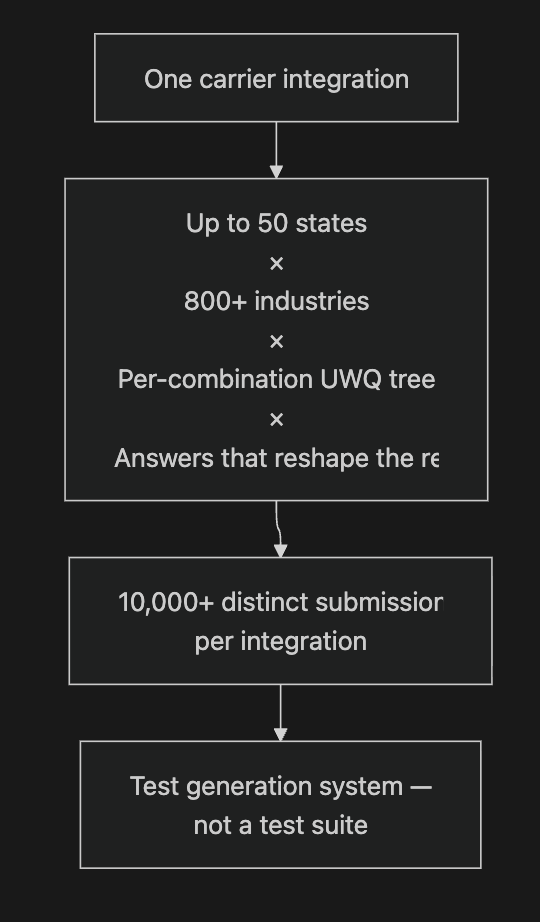
A single commercial carrier integration can span up to fifty states, eight hundred or more industries the carrier writes, and a different set of underwriting questions for every state-and-industry combination. The answers are not inert. Answering one UWQ a particular way can add new class codes, replace the primary class, and bring in a whole new question set on top. The space of valid submissions runs into well over ten thousand distinct scenarios per integration — easily more — and almost none of them can be exercised by a static fixture.
The first thing you build, then, is not a test suite. It's a test-generation system. Something that walks the carrier's appetite, picks representative state-and-industry combinations, fetches the UWQ tree for each one, generates plausible answers, exercises the dependent branches, and asserts on the responses. We've built one. It is not optional. A team that ships a carrier integration without it is shipping a demo of three submissions and calling it tested.
Sandbox stability and fidelity vary by carrier
Once you can generate tests, the next thing you learn is that the sandbox you're testing against is not always stable, and isn't always meant to be.
Three patterns we've hit, in roughly descending order of this is fine.
The first is the sandbox that's simply down a lot. One major carrier we integrate with runs a test environment that's unavailable for close to ten hours every day. Any team building against it plans dev-test cycles around when the carrier's sandbox is actually up.
The harder pattern is the moving-target sandbox — a place where the carrier's own engineering team ships changes faster than production, and where the contract you tested against on Tuesday may differ on Thursday with no version bump and no release note. Sandbox isn't broken here; it just isn't meant to be a frozen replica of production. If your testing strategy assumed otherwise, you have a regression suite that quietly stops asserting what it thinks it's asserting.
And the worst pattern: no usable sandbox at all. You test against production with rate limits and a wink, and you triple-check every assertion because the cost of a wrong call is a real submission against a real broker code.
None of these patterns hit every carrier. That's the point. The variance is the tax — you can't plan one testing strategy and apply it to thirty carriers, because each carrier's sandbox has its own pathology and its own posture toward backward compatibility.
And even when sandbox is stable, it doesn't match production
Even sandboxes that stay up and stay stable do not always match production. Minimum premiums in staging that don't reflect production minimums. Appetite in staging that doesn't reflect production appetite. Carrier-side error patterns that only show up under real concurrent load. Carrier engineering teams who don't test alongside you, so questions the carrier's own API quietly requires only surface when production rejects a quote. The contract on paper and the contract in production are two different documents, and only one of them is enforceable.
The testing layer most build estimates skip
A serious carrier integration testing layer covers five disciplines. We've named the five layers of the integration stack before; testing is the layer underneath them.
Contract tests against the carrier's spec, asserting on the response body's business meaning — not just on HTTP status. Differential checks that compare sandbox behavior to production behavior on the same input and alert when they diverge. Pre-flight data validators that catch bad FEINs, junk class codes, payroll outside plausible bounds, and addresses the carrier won't accept before the request ever leaves your system. Production canaries — small, dollar-clamped real submissions exercised against the live carrier on a known cadence, so that drift is detected against the only contract that matters. And chaos-style failure injection against your own integration code, so that when the carrier's auth expires mid-request, returns a 500, or delivers a webhook out of order, your code already knows what to do.
The visible scope of an integration is the API calls. The invisible scope is this layer.
A concrete reason this layer matters
A recent workers' comp integration gave us a clean test cycle. Every staging call returned an HTTP 200 in around three hundred milliseconds. Latency was healthy. The contract looked stable. We launched. A few weeks later, over a six-and-a-half-hour window, six real submissions failed in production with a generic internal error message. Every one of those calls had returned an HTTP 200. The error was buried inside the response body — a structured payload with a status code that said Error nested three levels deep. Our adapter, written against what the documentation called a successful response shape, classified the response as a success and returned the parsed object to the caller. The retry wrapper we had carefully built — three attempts, exponential backoff, ten-second floor — never fired, because nothing upstream of it told it to. The carrier had a single backend node behaving badly, and our test suite had no assertion strong enough to notice.
Sandbox didn't reproduce it. Status-code monitoring didn't catch it. We caught it because of our monitoring of declined quotes. The fix was four lines of code.
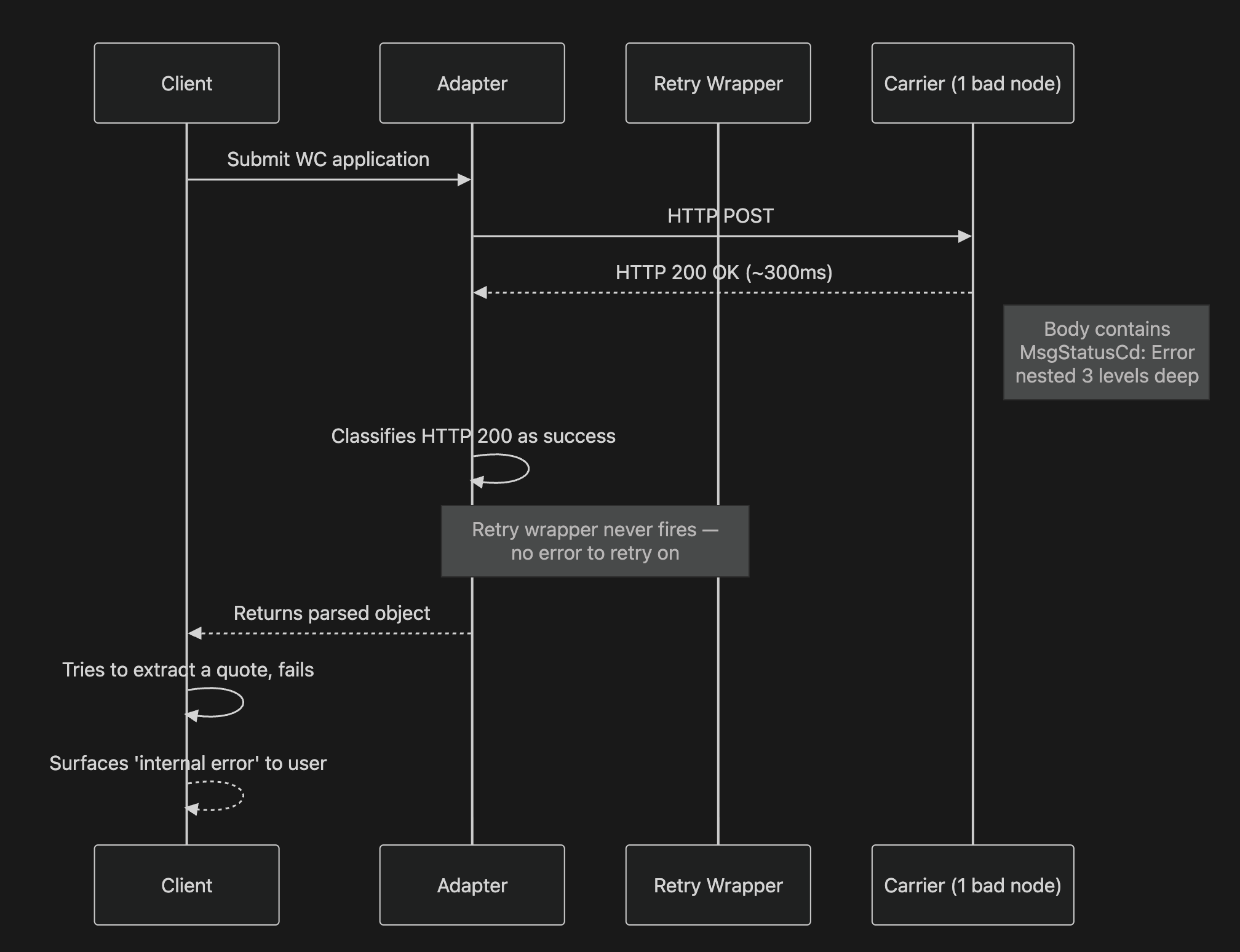
The lesson was larger. HTTP 200 is not successful. Until your contract tests assert on the response body's business meaning, the retry and error-classification layers you've built downstream are flying blind. That isn't a code problem; it's a testing problem.
Only production is production
Which brings us to the principle that names this discipline. Sandbox is a useful approximation of how a carrier intends to behave. Production is how the carrier actually behaves at three in the morning under load with a single backend instance misrouting traffic. The two diverge.
The only honest defense is a layer that asserts about production as it runs — dollar-clamped canaries on a known cadence, differential checks against staging, and per-carrier monitoring that watches for the kinds of drift no carrier will announce. We'll go deep on the monitoring framework in Part 9.
The visible integration is the API code. The invisible — and larger — integration is everything you build to know whether it's actually working.
If you're evaluating an in-house build, the testing layer is where the cost stack is most invisible up front. A two-engineer team can build a competent API client. The test-generation system, the differential-check tooling, and the production canaries are a separate engineering effort entirely — and they have to stay current across every carrier, every line, every state. That work has to land before the integration is trustworthy, and most build estimates don't name it.
For the full lifecycle, see Anatomy of a Carrier Integration.

.png&w=1920&q=75)